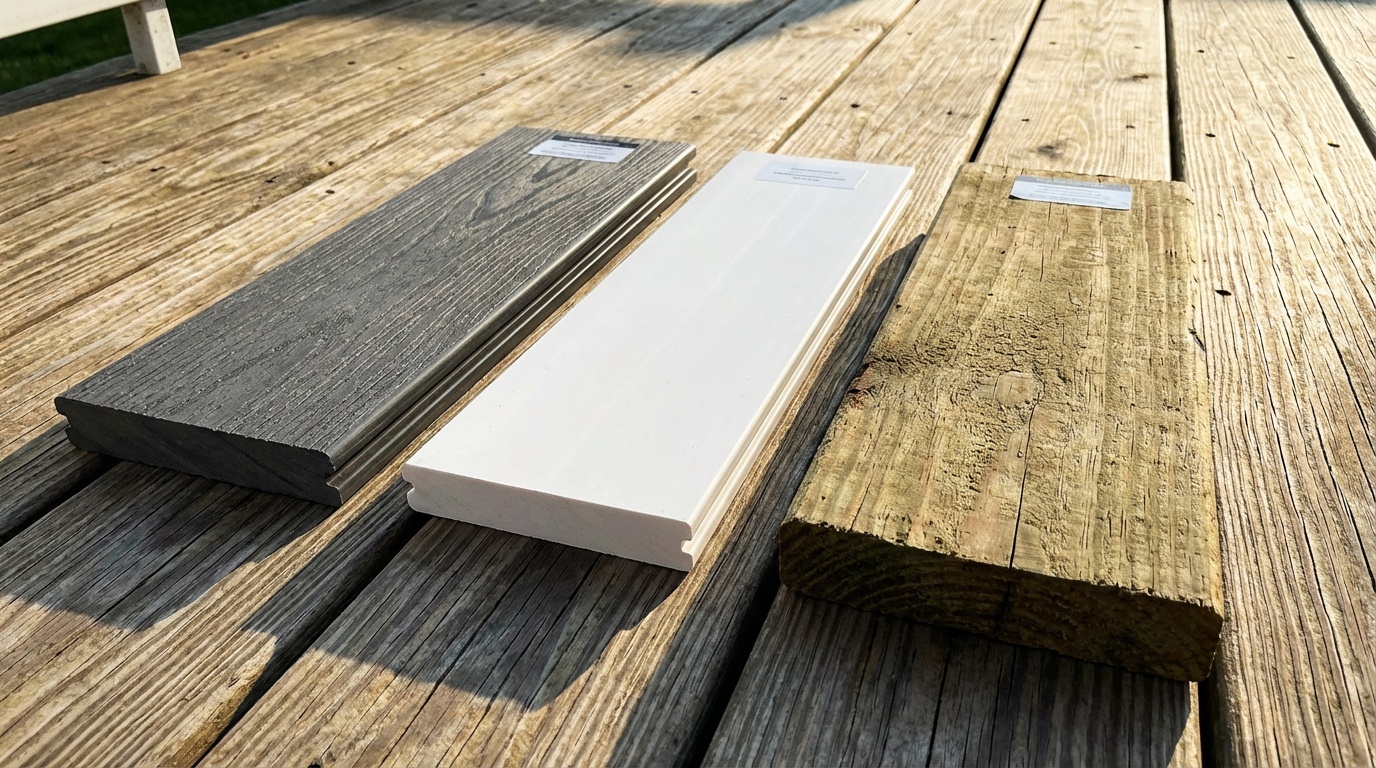
Composite vs. PVC vs. Pressure-Treated Decking: Which Is Best for You?
Reading time: 14 minutes
Picture this: You’ve just moved into your dream home. The backyard has incredible potential — a sprawling canvas just waiting for a gorgeous outdoor living space. You’re ready to build a deck. But then you visit the lumber yard and immediately face a wall of choices, each with its own price tag, warranty, and salesperson eager to convince you that their product is the obvious winner.
Sound familiar? You’re not alone. In 2026, the decking market has never been more complex — or more exciting. Homeowners across North America are spending an average of $15,000 to $22,000 on deck installations, making this one of the most significant home improvement investments you’ll make. Getting the material choice wrong doesn’t just hurt your wallet; it affects every summer barbecue, every morning coffee on the patio, and every eventual resale negotiation for years to come.
Here’s the straight talk: There’s no single “best” decking material. There’s only the best material for your specific situation. This guide is built to help you find exactly that — cutting through marketing noise with real data, honest tradeoffs, and practical guidance.
Table of Contents
- The Three Contenders: A Quick Overview
- Composite Decking: The Premium Middle Ground
- PVC Decking: The Waterproof Workhorse
- Pressure-Treated Wood: The Tried-and-True Classic
- Head-to-Head Comparison Table
- Cost vs. Longevity: At-a-Glance Chart
- 3 Common Challenges — and How to Solve Them
- Real-World Case Studies
- Frequently Asked Questions
- Your Deck Decision Roadmap
The Three Contenders: A Quick Overview
Before we dive deep, let’s set the stage. The three dominant decking materials competing for your project budget in 2026 are:
- Composite Decking — A blend of wood fiber and recycled plastic, engineered for aesthetics and durability.
- PVC Decking — 100% synthetic cellular PVC, offering the highest moisture resistance on the market.
- Pressure-Treated (PT) Wood — Natural lumber chemically treated to resist rot, insects, and decay.
Each of these materials has evolved significantly over the past decade. According to the North American Deck and Railing Association (NADRA), composite and PVC products now account for 52% of all new residential deck installations in 2026, up from just 34% in 2018. Yet pressure-treated wood remains deeply entrenched — and for good reason. Understanding why requires a detailed look at each material.
Composite Decking: The Premium Middle Ground
Composite decking has undergone a remarkable transformation since its early days of warping, fading, and mold issues. Today’s leading composite boards — think Trex Transcend, TimberTech AZEK (now technically a PVC-composite hybrid), and Fiberon Horizon — are engineered products that genuinely deliver on their promises.
What Makes Modern Composite Special
The core innovation in composite decking is the capped composite design. Unlike older uncapped boards that left wood fiber exposed to moisture, capped composite wraps every board in a protective polymer shell on three or four sides. This dramatically reduces moisture absorption, staining, and fading — the three biggest historical complaints about composite decking.
In 2025, Trex released third-party testing data showing their Transcend line retains over 95% of its original color after 25 years of UV exposure simulation. That’s a meaningful claim for anyone who’s watched a neighbor’s old composite deck turn chalky gray after just five years.
Material costs for quality composite in 2026 typically run $4.50 to $9.00 per linear foot for the boards alone, with premium capped products at the higher end. When you factor in hidden fastener systems, which composite almost universally requires for a clean finish, expect to add another $0.50 to $1.20 per square foot.
Composite’s Real-World Performance Profile
Where composite genuinely shines is in low-maintenance living. No staining, no sealing, no annual sanding. A quick wash with soapy water or a gentle pressure wash once or twice a year is all most composite decks need. For busy families, that’s a lifestyle advantage that’s hard to put a dollar figure on.
On the downside, composite still contains organic wood fiber, which means it’s not entirely immune to mold in persistently shaded, damp environments. It also conducts more heat than PVC — a legitimate comfort concern in climates like Arizona or Texas where surface temperatures can spike dramatically on summer afternoons. And while composite has improved enormously, it still doesn’t replicate the tactile warmth and grain variation of real wood to every eye.
Best for: Homeowners who want the look of wood without heavy maintenance, in moderate to warm climates with reasonable sun exposure.
PVC Decking: The Waterproof Workhorse
If composite is the balanced all-rounder, PVC decking is the specialist — engineered for environments where moisture is the primary enemy. Made from 100% cellular polyvinyl chloride with zero organic material, PVC boards are genuinely impervious to rot, mold, and insect damage in a way that no wood-based product can match.
Where PVC Has No Equal
Coastal homeowners, lake house builders, and anyone installing a deck over or near water should give PVC very serious consideration. In salt-air environments — think the Outer Banks of North Carolina, coastal Maine, or the Florida Gulf Coast — wood and even composite decking degrade measurably faster due to the combination of humidity, salt, and UV exposure. PVC is chemically inert to all of these forces.
Brands like AZEK, Versatex, and Wolf PVC have all introduced proprietary cap systems that dramatically improve scratch resistance and color retention, addressing the two biggest historical criticisms of PVC decking. The 2025 generation of capped PVC products now carry lifetime limited warranties from most major manufacturers — a level of confidence that speaks directly to the material’s long-term durability.
Material costs for PVC in 2026 run approximately $7.00 to $11.00 per linear foot, making it the most expensive of our three options upfront. However, when you calculate total cost of ownership over a 25-to-30-year period — factoring in zero maintenance costs, no staining, and no board replacement — PVC often becomes the most economically rational choice for high-moisture environments.
The main criticisms of PVC are worth understanding honestly. It expands and contracts more dramatically than composite or wood with temperature fluctuations, requiring careful installation with proper gap spacing — a point that separates skilled installers from inexperienced ones. It also has a slightly hollow sound when walked on, which bothers some homeowners who associate it with a less “solid” feel. And its aesthetic, while vastly improved, still reads as synthetic to trained eyes, particularly in longer board runs.
Best for: Coastal properties, pool surrounds, docks, covered porches, and any environment with chronic moisture exposure.
Pressure-Treated Wood: The Tried-and-True Classic
Don’t let the composite and PVC conversation convince you that pressure-treated wood is obsolete. In 2026, PT decking remains the most widely installed decking material in the United States by volume, and it maintains that position for entirely rational reasons.
The Economics of Pressure-Treated Wood
The upfront cost advantage of pressure-treated wood is simply undeniable. In 2026, PT deck boards are running approximately $1.50 to $3.50 per linear foot — roughly one-third to one-fifth the cost of premium composites and PVC products. For a 400-square-foot deck, that difference in material costs alone can be $3,000 to $6,000 or more.
Modern pressure-treated lumber uses alkaline copper quaternary (ACQ) or copper azole (CA) preservative treatments, which replaced the older arsenic-based CCA treatments phased out in the early 2000s. These modern treatments are more environmentally responsible and have become more effective over time. Southern Yellow Pine, the most common PT decking species in the eastern U.S., holds preservative treatment exceptionally well and offers strong structural performance.
The True Maintenance Commitment
Here’s where PT wood requires honest conversation. A pressure-treated deck demands active maintenance if you want it to look good and last its potential 15-to-25-year lifespan. New PT lumber needs to dry for 3 to 6 months before it accepts stain or sealer effectively. After that, expect to apply a quality deck stain or sealer every 2 to 3 years, sand rough surfaces periodically, replace individual boards that crack or splinter, and treat any exposed cuts with end-cut solution.
The cumulative cost of this maintenance — materials plus time or contractor fees — typically runs $500 to $1,500 every few years for an average-sized deck. Over a 20-year period, that can add $4,000 to $8,000 to your total cost of ownership, substantially narrowing the initial price gap with composite alternatives.
That said, PT wood offers something no engineered product can fully replicate: the authentic warmth, workability, and visual character of natural wood. It’s also the most repair-friendly option — a single damaged board costs a few dollars and can be replaced in minutes with standard carpentry skills.
Best for: Budget-conscious homeowners, DIY builders, those who genuinely enjoy wood maintenance, and projects where structural framing costs are a priority.
Head-to-Head Comparison Table
| Metric | Composite | PVC | Pressure-Treated |
|---|---|---|---|
| Material Cost (per lin. ft.) | $4.50–$9.00 | $7.00–$11.00 | $1.50–$3.50 |
| Expected Lifespan | 25–30 years | 30+ years | 15–25 years |
| Maintenance Level | Very Low | Minimal | High |
| Moisture Resistance | Good (capped) | Excellent | Moderate |
| Aesthetic Authenticity | Good | Fair | Excellent |
Cost vs. Longevity: At-a-Glance Chart
The chart below visualizes the estimated 30-year total cost of ownership (materials + installation + maintenance) for a 400 sq. ft. deck, based on 2026 contractor pricing averages.
*Note: PT wood’s 30-year figure assumes one full deck rebuild at year 20. PVC and premium composite assume no board replacement over 30 years. All figures include professional installation.
3 Common Challenges — and How to Solve Them
Challenge 1: Sticker Shock on Composite and PVC
The most common reaction homeowners have when getting composite or PVC quotes is immediate sticker shock. A premium composite deck that costs $28,000 installed versus $14,000 for pressure-treated feels like an insurmountable gap. But here’s the reframe: evaluate it as a financial instrument, not a one-time purchase.
Spread the cost delta over the expected lifespan. If you save $1,000 every two years on staining and maintenance, that’s $10,000 over 20 years. Add the value of your own time — a full deck staining weekend is easily 12 to 16 hours of labor. Calculate what that time is worth to you. For many homeowners, the “expensive” option becomes the rational one within a 7-to-10-year payback window.
Practical tip: Ask contractors to quote a hybrid approach — composite decking boards over a pressure-treated subframe. This is already the industry standard and cuts costs compared to all-composite construction while delivering the low-maintenance surface you want.
Challenge 2: Climate Mismatch
Many homeowners choose decking based on what looks good in a showroom, not what performs in their specific climate. This leads to composite decks becoming uncomfortably hot in Phoenix, PVC decks experiencing excessive gapping in Minnesota winters, and pressure-treated wood rotting prematurely in the Pacific Northwest’s wet climate.
The fix is simple: Before selecting your material, research the specific climate performance ratings for your region. Most manufacturers publish regional performance data. In hot, sunny climates, look for composite products with heat-reducing technology — Trex, for example, markets boards with cooler surface temperatures. In freeze-thaw climates, verify your PVC product’s expansion coefficient and ensure your installer uses manufacturer-recommended spacing. In persistently wet climates, upgrade to capped composite or PVC and ensure your subframe has excellent drainage design.
Challenge 3: Warranty Fine Print Confusion
Decking warranties in 2026 have become marketing battlegrounds. “25-year warranty,” “lifetime warranty,” “fade and stain warranty” — these phrases sound compelling until you read the exclusions. Common warranty limitations include: coverage only for manufacturer defects (not weathering), requirements for specific cleaning products, geographic exclusions for coastal environments, and pro-rated coverage that diminishes over time.
What to actually do: Request the full warranty document before purchase — not just the marketing summary. Specifically check three things: (1) Is the warranty transferable to a future buyer? A transferable warranty adds genuine resale value. (2) What are the maintenance requirements to keep the warranty valid? (3) What is the claims process, and does it cover labor costs for board replacement? A warranty that covers materials but not labor is only half a warranty.
Real-World Case Studies
Case Study 1: The Coastal Condo Deck in Hilton Head, SC
In 2022, a vacation property owner in Hilton Head, South Carolina replaced a 12-year-old pressure-treated deck that had been continuously battling salt air, high humidity, and UV exposure. The deck had been stained or sealed four times, had experienced significant board checking and splitting, and several boards near the perimeter required replacement. Total maintenance investment over 12 years: approximately $4,200.
The replacement choice was AZEK capped PVC decking in Coastline color. As of spring 2026 — four years later — the deck shows zero visible weathering, has required only annual washing, and the property manager reports consistently strong feedback from rental guests about the deck’s appearance and comfort. The higher upfront investment of approximately $9,800 more than the comparable PT estimate is tracking toward breakeven within another 5 to 6 years.
Case Study 2: The Budget-Conscious Family Deck in Columbus, OH
A family in suburban Columbus, Ohio built a 320-square-foot ground-level deck in 2023 with a hard budget ceiling of $8,500 including installation. Composite was out of budget; PVC was out of the question. They chose pressure-treated Southern Yellow Pine with a quality semi-transparent stain applied after a proper 4-month drying period.
Now three years in, the deck is performing well. They’ve done one re-stain at roughly $280 in materials and a weekend’s work. The husband reports he actually enjoys the annual inspection and touch-up process — for him, it’s satisfying hands-on homeownership. They plan to replace the deck boards around 2035 to 2038 and will reassess material options at that point. Sometimes the right answer is simply the one you can afford to do properly.
Case Study 3: The Pool Surround in Scottsdale, AZ
A Scottsdale homeowner installing a 500-square-foot pool surround in late 2024 initially priced composite decking. After consulting with a local contractor, they learned that surface temperatures on standard composite boards in direct Arizona sun had been measured at 140°F to 160°F during peak summer afternoons — genuinely uncomfortable for bare feet. They switched to Fiberon Paramount PVC in a lighter color, which demonstrated meaningfully cooler surface temperatures in independent testing. The lighter color combined with PVC’s lower heat absorption solved the comfort equation. One year later, they report high satisfaction despite the premium price.
Frequently Asked Questions
Is composite decking worth the extra money over pressure-treated?
For most homeowners who value low maintenance and plan to stay in their home for 10 or more years, yes — capped composite decking is worth the premium. The math typically works in composite’s favor when you account for cumulative maintenance costs (staining, sealing, board replacement) over a 15-to-20-year period. However, if you’re working within a tight budget, plan to sell within 5 years, or genuinely prefer natural wood aesthetics and don’t mind regular maintenance, pressure-treated remains an entirely rational and respectable choice. The “worth it” calculation is deeply personal and depends on your time, budget, and how you use your outdoor space.
Can I install composite or PVC decking myself, or do I need a professional?
Experienced DIYers can absolutely install composite and PVC decking — both materials are designed for standard installation with basic carpentry tools. However, there are important nuances. Composite and PVC almost universally use hidden fastener systems rather than face screws, which require specific tools and careful technique. PVC requires precise gap spacing to accommodate thermal expansion, and getting this wrong leads to board buckling in summer heat. If you’re confident with carpentry, read the manufacturer’s installation guide thoroughly and consider tackling the decking boards yourself over a professionally built PT subframe — a hybrid approach that balances savings with quality.
How does my choice of decking material affect my home’s resale value?
According to Remodeling Magazine’s 2025 Cost vs. Value Report, composite deck additions recoup an average of 68% to 73% of their cost at resale, compared to approximately 60% to 65% for pressure-treated decks in comparable markets. In premium coastal markets, those numbers tilt further toward composite and PVC. The key insight: buyers increasingly factor in maintenance costs when evaluating homes, and a composite or PVC deck signals lower future maintenance obligations — a genuine value proposition in a competitive market. A transferable manufacturer warranty on composite or PVC decking is a specific selling feature worth highlighting in any future listing.
Your Deck Decision Roadmap: Build With Confidence
As outdoor living continues to be one of the fastest-growing segments of the home improvement market — NADRA projects the U.S. decking market will exceed $12 billion annually by 2027 — making the right material choice has never mattered more. Here’s how to move from information to confident decision:
- Step 1 — Define your non-negotiables. Is it budget? Maintenance freedom? Environmental sustainability? Authentic wood look? Write down your top two or three priorities before talking to any contractor or retailer.
- Step 2 — Assess your climate honestly. Look up your local average rainfall, humidity levels, UV index, and temperature swings. Match material performance data to your actual environment, not an idealized one.
- Step 3 — Get three quotes — one per material type. Ask each contractor to price the same design in all three materials. This gives you an apples-to-apples cost comparison you can actually evaluate.
- Step 4 — Read the warranty document, not just the summary. Transferability, maintenance requirements, and labor coverage are your three critical checkpoints.
- Step 5 — Request samples and visit installed decks. Most manufacturers will connect you with local homeowners who have installed their products. Seeing a 5-year-old deck in your climate is worth more than any brochure.
The outdoor living revolution isn’t slowing down. As smart home technology increasingly extends into backyard spaces and sustainable building materials gain regulatory momentum in municipalities across North America, your decking choice is becoming more integrated into the bigger picture of how you live — and how your home performs as a long-term asset.
Here’s the question worth sitting with: Ten years from now, when you’re hosting a summer gathering on your deck, do you want to be proud of a low-maintenance space that looks as good as the day it was built — or satisfied that you made a smart, budget-conscious choice that you’ve maintained with your own hands? Neither answer is wrong. The right deck is the one that fits your life, your climate, and your honest budget — not someone else’s version of the perfect outdoor space.
Now go build something great.
Article reviewed by Gary Kowalski, Structural Demolition & Load-Bearing Analysis Expert, on May 4, 2026