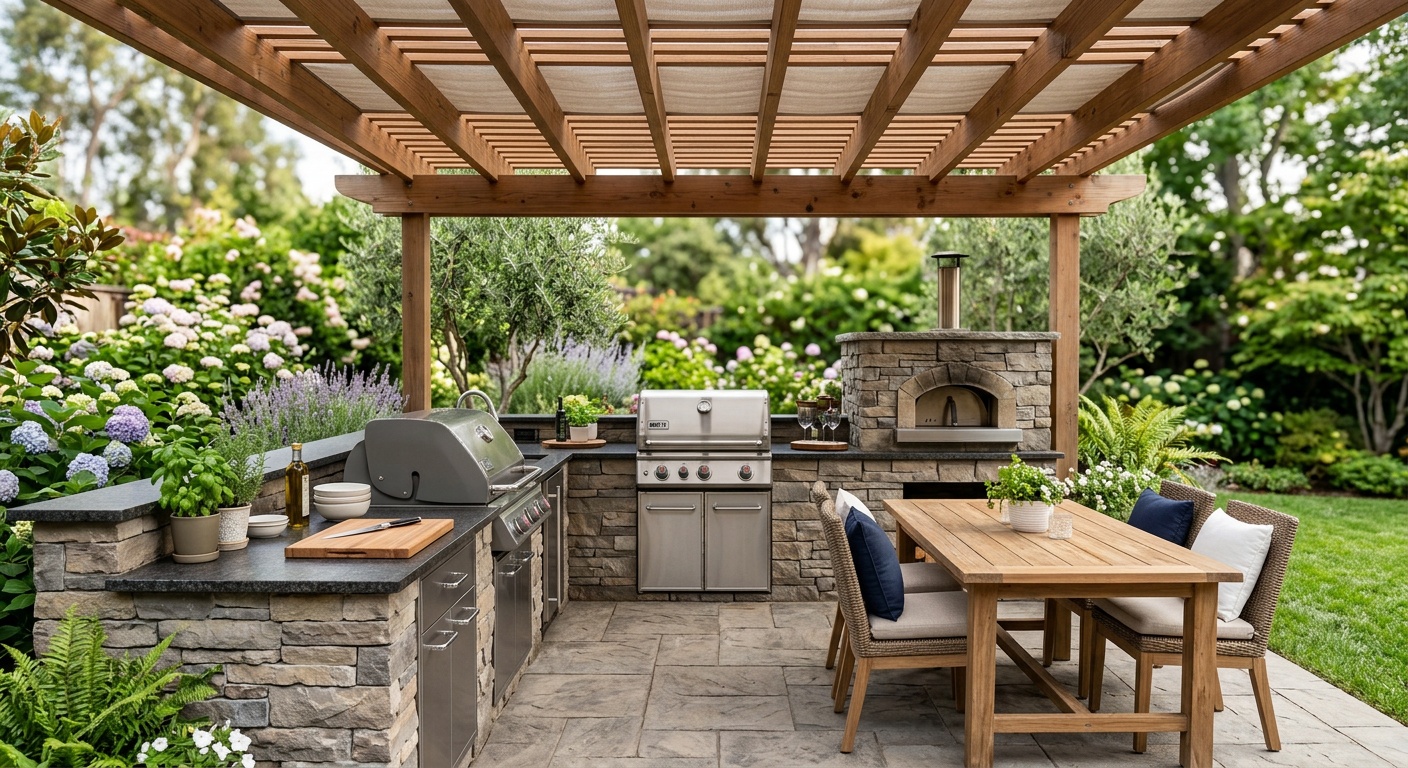
Outdoor Kitchen Design Tips for Extreme Summer Heat: Build Smarter, Cook Cooler
Reading time: 12 minutes
Ever stepped outside to fire up the grill in July, only to feel like you’re cooking inside a solar oven? You’re not cooking for guests anymore — you’re just surviving. Outdoor kitchens have exploded in popularity since 2022, but most homeowners make the same critical mistake: they design for aesthetics first and climate resilience dead last.
Here’s the straight talk: In 2026, with average summer temperatures hitting record highs across the American Southwest, Mediterranean Europe, and Southeast Asia, designing an outdoor kitchen without factoring in extreme heat isn’t just uncomfortable — it’s a safety hazard, a budget drain, and a recipe for equipment failure before the warranty expires.
This guide is your comprehensive blueprint for building an outdoor kitchen that doesn’t just survive brutal summer heat — it thrives in it. Whether you’re planning from scratch or retrofitting an existing setup, we’ll walk you through material selection, shade engineering, ventilation strategy, appliance placement, and smart design principles that professionals use on high-end projects.
Table of Contents
- Why Extreme Heat Changes Everything
- Shade Structures: Your First Line of Defense
- Material Selection for High-Heat Environments
- Ventilation and Airflow Design
- Appliance Placement and Heat Management
- Creating Cooling Zones That Actually Work
- Real-World Case Studies
- Material Comparison Table
- Frequently Asked Questions
- Your Heat-Ready Kitchen: Build It Right the First Time
Why Extreme Heat Changes Everything About Outdoor Kitchen Design
The National Oceanic and Atmospheric Administration reported in early 2026 that 2025 was the third consecutive year to break global average temperature records. For outdoor kitchen owners in Phoenix, Las Vegas, Miami, or any climate zone above USDA Zone 9, summer afternoons regularly push ambient temperatures past 105°F (40°C). Add radiant heat from cooking surfaces and reflected heat from concrete or tile surfaces, and the microclimate around your grill can exceed 130°F.
This isn’t just uncomfortable. It causes real, measurable damage:
- Cabinetry delamination — polymer and wood-composite doors warp and separate within 2–3 seasons
- Sealant failure — grout and caulk around countertops degrade 40% faster in sustained UV + heat exposure
- Appliance overheating — refrigeration units in direct sun work 3–5× harder, drastically shortening compressor life
- Safety risks — heat exhaustion and dehydration become genuine dangers for the cook during extended sessions
Understanding the concept of thermal mass is foundational here. Materials with high thermal mass — like concrete, stone, and brick — absorb enormous amounts of heat during the day and radiate it back at night. This is fantastic for passive heating in cold climates, but in a summer outdoor kitchen, it can mean your countertop is still uncomfortably hot at 9 PM. Smart design anticipates this physics and works with it, not against it.
Bottom line: Every design decision — from material choice to appliance orientation — needs to be filtered through a single question: How does this perform at 108°F in direct afternoon sun?
Shade Structures: Your First Line of Defense
If you do nothing else on this list, build a serious shade structure. A well-designed shade canopy can reduce the perceived temperature in your outdoor kitchen by 10–20°F instantly, protect surfaces from UV degradation, and make extended cooking sessions genuinely enjoyable rather than a test of endurance.
Pergolas, Pavilions, and Solid Roofs: Choosing the Right Overhead
Not all shade structures are created equal, and the difference between a decorative pergola and a functional outdoor kitchen roof is enormous.
Open-lattice pergolas are beautiful but provide only partial shade — typically 50–70% depending on slat density and sun angle. For a casual seating area, that might be fine. For a working kitchen in Texas in August? You’ll still be sweating through your apron by noon.
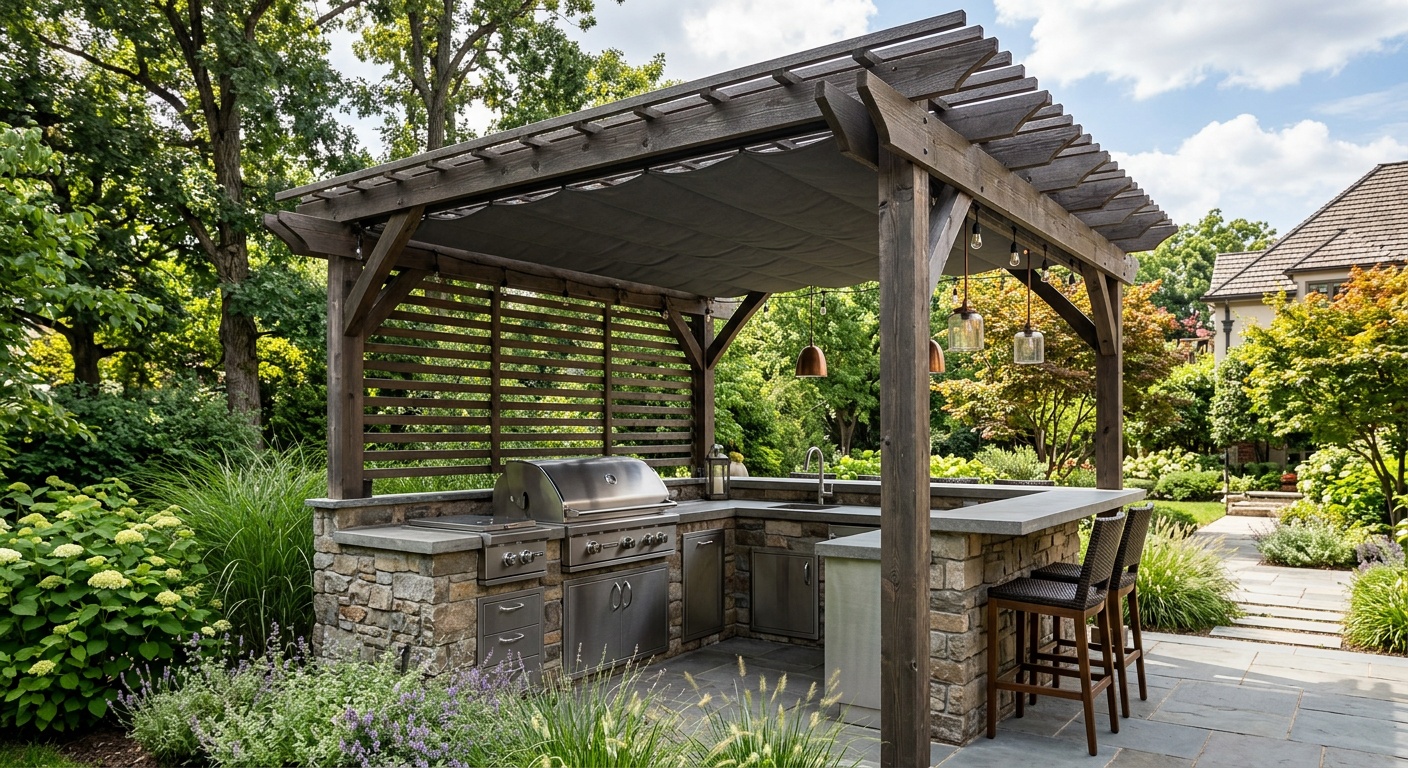
Solid-roof pavilions — built from aluminum, steel, or insulated panels — provide full shade and allow for integrated ventilation, lighting, and even ceiling fans. According to a 2025 survey by the National Kitchen and Bath Association, 68% of outdoor kitchen projects over $25,000 now include a solid or semi-solid overhead structure, up from 41% in 2021.
Insulated roof panels deserve special mention. Products like insulated aluminum composite panels create a thermal barrier above the cooking zone, preventing solar heat gain from radiating down onto the cook and the countertops. In high-heat climates, this single upgrade can reduce surface temperatures by 15–25°F compared to uninsulated metal roofing.
Orientation and Sun Path Planning
Here’s a tip most design guides skip entirely: your outdoor kitchen’s orientation relative to the sun’s path is arguably as important as any material choice.
- West-facing kitchens absorb brutal afternoon sun — the hottest hours of the day. This is the worst orientation in high-heat climates unless you have full overhead shading.
- East-facing kitchens get morning sun and afternoon shade — far more manageable.
- South-facing layouts (in the Northern Hemisphere) maximize overhead sun exposure year-round. Great for winter use; punishing in summer without proper shade.
- North-facing setups stay the coolest in summer but may feel dark and cold in winter months.
Before finalizing any outdoor kitchen design in 2026, run a basic sun path simulation. Free tools like the SunCalc app or Google’s Project Sunroof can show exactly how the sun moves across your specific property at any hour across all seasons. Spending 20 minutes with one of these tools can save you thousands in retroactive shade additions.
Pro Tip: Combine orientation planning with a 2–3 foot roof overhang extension on the west and south sides. This simple architectural move blocks low-angle afternoon sun that a standard roof won’t catch — dramatically reducing direct solar exposure on cooking surfaces during peak heat hours.
Material Selection for High-Heat Environments
Choosing materials for an outdoor kitchen in an extreme heat zone requires a completely different mindset than a temperate-climate build. Durability, thermal performance, UV resistance, and heat reflectivity all need to weigh into every selection.
Countertop Materials: What Holds Up and What Doesn’t
Porcelain tile and sintered stone are the top performers in 2026 for extreme heat environments. These materials are non-porous, UV-stable, and maintain structural integrity at temperatures far beyond what any outdoor kitchen will experience. Brands manufacturing ultra-compact sintered stone products have seen demand surge 34% in Sun Belt states over the past two years, according to industry trade data published in early 2026.
Natural granite remains a solid choice — it’s heat-resistant and UV-stable — but requires annual sealing in hot, dry climates where thermal cycling causes micro-expansion and contraction that gradually opens the stone’s pores.
Concrete countertops are popular for their aesthetic flexibility, but in extreme heat zones they require high-quality penetrating sealers reapplied every 12–18 months. Unsealed or poorly sealed concrete in desert climates can stain, crack, and harbor bacteria in outdoor cooking environments.
What to avoid: Quartz countertops are not suitable for direct outdoor sun exposure regardless of what some retailers claim. The resin binders in quartz can yellow, warp, and delaminate with sustained UV and thermal cycling. Most quartz manufacturer warranties explicitly exclude outdoor applications — read the fine print.
Cabinet and Frame Materials
The outdoor kitchen cabinet market has matured significantly. Here’s the current hierarchy for heat-zone performance:
- Marine-grade 316 stainless steel — The gold standard. Resists heat, UV, moisture, and insects. Expensive but essentially maintenance-free for 15–20+ years.
- High-density polyethylene (HDPE) cabinetry — UV-stable, impervious to moisture, available in a range of colors. A strong value play that’s gained major market share since 2023.
- Powder-coated aluminum frames with polymer doors — Lightweight and rust-proof, but door quality varies widely. Stick to UV-stabilized polymer doors rated for direct sun exposure.
- Treated wood or wood composites — Acceptable in mild climates; problematic in extreme heat zones where thermal expansion causes warping, cracking, and finish failure within a few seasons.
Ventilation and Airflow Design
Even the best shade structure becomes a heat trap without intentional airflow design. Many homeowners build a covered outdoor kitchen and then wonder why it feels hotter under the roof than in the open yard — the answer is almost always poor ventilation.
Heat rises, and in an outdoor kitchen with a solid overhead structure, cooking heat from grills, smokers, and side burners accumulates under the roof and stagnates. Effective ventilation design addresses this through three mechanisms:
- Ridge vents or ridge gaps — allowing hot air to escape from the highest point of the roof structure
- Ceiling fans — moving air horizontally to prevent stratification and create perceived cooling through the wind-chill effect
- Grill-specific ventilation hoods — capturing combustion gases and cooking heat directly at the source before they spread through the kitchen zone
A professional-grade outdoor ventilation hood should move a minimum of 600 CFM (cubic feet per minute) for a standard 36-inch grill, and up to 1,200 CFM for commercial-style setups. In 2026, smart ventilation systems with temperature-activated variable-speed fans are becoming increasingly accessible at the residential level — these automatically ramp up airflow as cooking temperatures rise, maintaining a more consistent thermal environment.
Don’t overlook under-counter ventilation. Appliances like refrigerators, ice makers, and warming drawers generate significant heat from their compressors and mechanical components. In fully enclosed outdoor cabinetry without ventilation gaps, this heat accumulates and forces appliances to work harder, reducing efficiency by 20–40% and shortening equipment lifespan considerably.
Appliance Placement and Heat Management
Where you position your appliances matters as much as which appliances you choose. A thoughtful layout strategy can dramatically reduce heat load on both the cook and the equipment.
The core principle: separate heat-generating appliances from heat-sensitive ones. This sounds obvious, but it’s violated constantly in outdoor kitchen designs where aesthetic symmetry overrides functional logic.
Specific placement guidelines:
- Grills and side burners should be positioned downwind from the primary work and dining zones. Prevailing wind direction on your specific property should inform this decision — check with a local landscape architect or use a simple wind rose for your area.
- Outdoor refrigerators and wine coolers should be placed in the shadiest, most ventilated position available — ideally on a north or east-facing wall with several inches of clearance behind the unit.
- Pizza ovens and smokers generate heat in all directions for extended periods. These should be treated as standalone structures with minimum 3-foot clearance from countertops, overheads, and cabinetry. Many designers now locate these appliances slightly apart from the main kitchen run — still connected aesthetically but functionally isolated thermally.
- Sinks and prep areas should be adjacent to the cooking zone but in the shade-prioritized portion of the layout, making them more comfortable for extended food prep work.
Creating Cooling Zones That Actually Work
The smartest outdoor kitchens in 2026 don’t just try to resist heat — they actively engineer comfort zones for the people using them. This is the difference between an outdoor kitchen you use twice in July and one you use twice a week.
There are several effective approaches to active cooling in outdoor kitchen environments. Misting systems are extremely popular in dry climates — high-pressure mist systems can reduce ambient air temperature by 15–35°F through evaporative cooling, and in low-humidity environments like Arizona and Southern California, they feel remarkable without leaving surfaces or people uncomfortably wet.
Evaporative cooling technology has also advanced significantly. For partially enclosed outdoor kitchen structures, exploring air conditioner alternatives like personal evaporative coolers or portable spot coolers can create a genuinely comfortable cooking environment without the cost and complexity of installing ductless mini-split systems in an outdoor space.
Landscape-based cooling is often underutilized. Strategic placement of deciduous trees on the west and southwest sides of your outdoor kitchen zone provides seasonal shade exactly when you need it — leafy in summer to block sun, bare in winter to allow warming sunlight through. Fast-growing options like desert willow (in arid climates) or red maple (in humid climates) can provide meaningful shade within 3–5 years of planting.
Real-World Case Studies
Case Study 1: Scottsdale, Arizona — Full Outdoor Kitchen Rebuild
In 2025, a residential design firm in Scottsdale undertook a complete rebuild of an outdoor kitchen that had failed after just four seasons. The original build used quartz countertops, wood-composite cabinetry, and an open pergola. By the end of its fourth summer, the countertops had yellowed and warped, two cabinet doors had delaminated completely, and the outdoor refrigerator’s compressor had burned out — twice.
The rebuild used sintered stone countertops, 316 stainless steel cabinetry, and a fully insulated aluminum roof with integrated ridge ventilation and two variable-speed ceiling fans. The outdoor refrigerator was repositioned to a north-facing wall with 4 inches of rear clearance. A high-pressure misting system was added along the perimeter. Total rebuild cost was approximately $42,000.
The result: Through the entire summer of 2025, with multiple days exceeding 112°F, the kitchen zone remained functional and comfortable. The homeowner reported using the kitchen almost daily from April through October — compared to avoiding it entirely on hot days with the previous design.
Case Study 2: Miami, Florida — Humidity-Specific Challenges
Extreme heat design isn’t only about dry, arid climates. A Miami homeowner in 2024 built a $65,000 outdoor kitchen that faced a completely different set of challenges: high humidity combined with intense heat created a subtropical environment where mold, corrosion, and moisture damage were the primary enemies rather than thermal radiation.
Key adaptations that succeeded in this climate: marine-grade 316 stainless hardware throughout (regular stainless corrodes noticeably faster in salt-air, high-humidity environments), an open-air pavilion design that maximized cross-ventilation rather than a more enclosed structure, HDPE cabinetry that is genuinely impervious to moisture, and a countertop fabricated from large-format porcelain with minimal grout lines to reduce moisture infiltration points.
This case illustrates that “extreme heat design” must be climate-specific — the right solution for Phoenix is not the right solution for Miami.
Outdoor Kitchen Surface Material Comparison
| Material | Heat Resistance | UV Stability | Maintenance Level | Cost Range (per sq ft) |
|---|---|---|---|---|
| Sintered Stone | ⭐⭐⭐⭐⭐ | ⭐⭐⭐⭐⭐ | Very Low | $80–$150 |
| Porcelain Tile | ⭐⭐⭐⭐⭐ | ⭐⭐⭐⭐⭐ | Low | $25–$75 |
| Natural Granite | ⭐⭐⭐⭐ | ⭐⭐⭐⭐ | Moderate | $40–$100 |
| Concrete (Sealed) | ⭐⭐⭐ | ⭐⭐⭐ | High | $65–$135 |
| Quartz | ⭐⭐ | ⭐⭐ | Low (indoors only) | $50–$120 |
Heat Performance Ratings by Material Category
Sintered Stone
Porcelain Tile
Natural Granite
Concrete (Sealed)
Quartz (Outdoor Use)
Frequently Asked Questions
What is the single most impactful change I can make to an existing outdoor kitchen to reduce heat?
If your budget allows only one improvement, invest in a quality overhead shade structure — ideally an insulated solid-roof pavilion with integrated ceiling fans. This single addition addresses both direct solar radiation onto surfaces and the cook, and provides a foundation for ventilation improvements. Studies consistently show that shade alone reduces perceived ambient temperature by 10–20°F, which can transform an unusable summer kitchen into a genuinely comfortable cooking space. If a full structure isn’t feasible, a high-quality retractable awning on the west and south sides is your next best option.
How do I protect my outdoor refrigerator from failing in extreme summer heat?
Outdoor-rated refrigerators are specifically engineered to operate in ambient temperatures up to 110°F, but they still need help. Position the unit in the shadiest part of your layout, ensure at least 3–4 inches of clearance behind and above the unit for heat dissipation, and consider adding a small ventilation fan if it’s in an enclosed cabinet space. Avoid placing it adjacent to the grill or any heat-generating appliance. Additionally, use lighter-colored or reflective panel fronts on any cabinet housing the refrigerator to minimize solar heat absorption. Replacing the refrigerator’s condenser coil annually in dusty, desert environments also dramatically extends its lifespan.
Should I choose a covered or open-air design for a high-heat climate like Phoenix or Las Vegas?
In climates where summer temperatures consistently exceed 100°F, a covered design with solid or insulated roofing is almost always the better choice — but only if it’s properly ventilated. An open-air kitchen exposes every surface, appliance, and person to direct solar radiation all day. A covered kitchen eliminates direct sun but can trap heat if airflow isn’t engineered into the design. The ideal solution is an insulated solid roof with ridge ventilation, ceiling fans, and open sides (rather than enclosed walls) to maximize cross-ventilation. This combination delivers the shade benefits without the heat trap penalty, making your outdoor kitchen genuinely usable through even the most extreme summer days.
Your Heat-Ready Kitchen: Build It Right the First Time
The outdoor kitchen industry is at an inflection point in 2026. As climate patterns shift and summer heat intensifies across major population centers, the gap between a well-designed outdoor kitchen and a poorly designed one is widening — in cost, comfort, durability, and safety. Getting this right from the start isn’t just about luxury; it’s about smart investment protection and genuine usability.
Here’s your practical implementation roadmap:
- Audit your sun exposure first. Spend one week observing how the sun moves across your proposed kitchen site at different times of day. Identify the hours and angles of maximum heat exposure. This free, zero-tool exercise will inform every decision that follows.
- Lock in your shade structure before selecting any materials. The roof and overhead structure define the thermal environment everything else lives in. Choose insulated panels and plan integrated ventilation before you ever shop for countertops or appliances.
- Choose materials with a 10-year performance lens. Don’t buy what looks beautiful in the showroom. Ask specifically: “How does this perform in sustained UV exposure at 110°F?” Sintered stone and marine-grade stainless are your anchors.
- Separate heat sources from heat-sensitive elements. Map out your appliance placement with thermal logic — refrigeration in shade, grills downwind, pizza ovens isolated. Draw it before you build it.
- Layer your cooling strategy. Don’t rely on shade alone. Combine overhead protection with ceiling fans, misting systems, and smart landscape planting for a truly resilient, comfortable outdoor cooking zone.
As global temperatures continue trending upward through the late 2020s, the outdoor kitchens that age well will be the ones designed around climate reality rather than catalog aesthetics. This isn’t a niche concern for Sun Belt states anymore — it’s an increasingly universal design challenge for anyone who wants to cook outdoors comfortably in summer.
You now have the framework. The real question is: which of these changes can you implement before this summer’s first heat wave hits? Start with shade, build from there, and every grilling session for the next decade will be better for it.
Article reviewed by Gary Kowalski, Structural Demolition & Load-Bearing Analysis Expert, on June 8, 2026