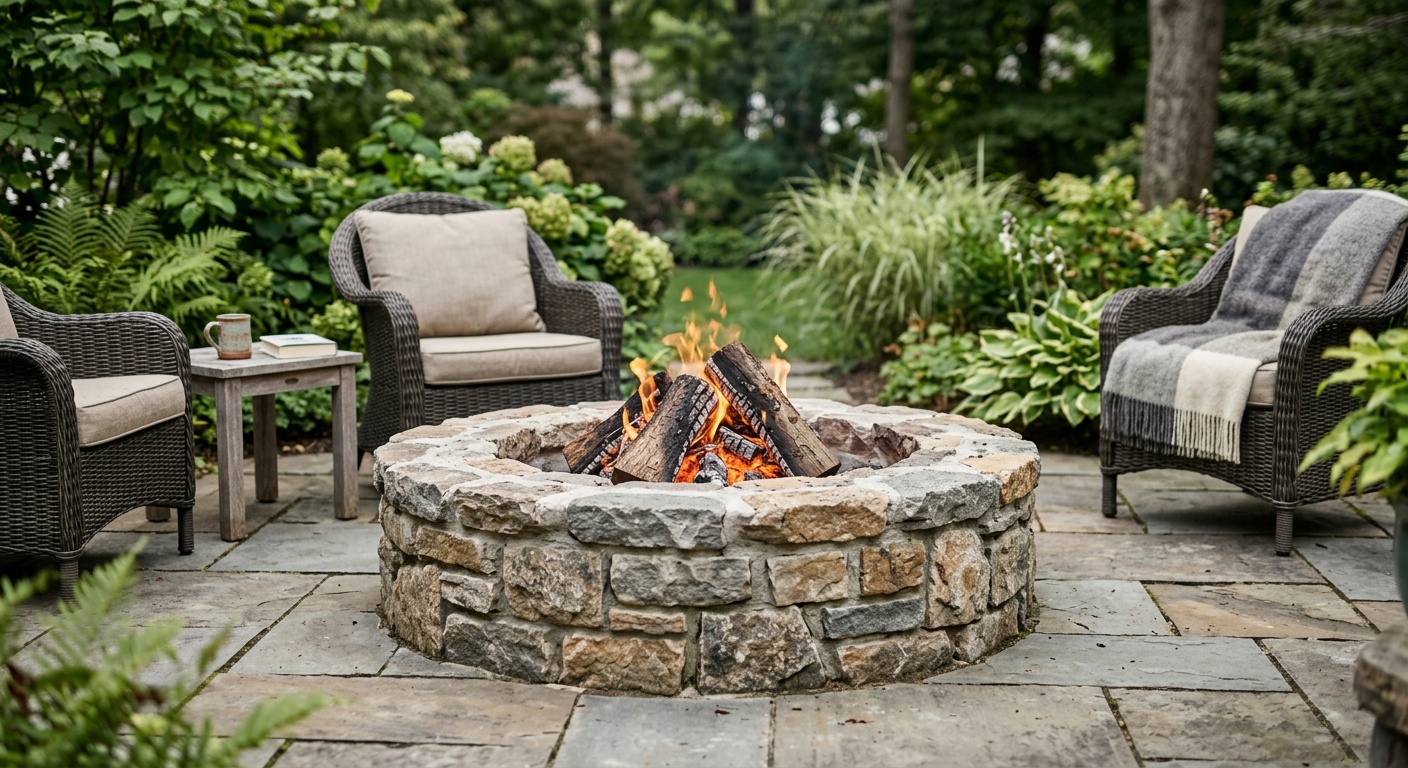
Stone Wall and Fire Pit Design Ideas for Backyards: Transform Your Outdoor Space in 2026
Reading time: 12 minutes
Picture this: a crisp autumn evening, the scent of woodsmoke curling through the air, your closest friends gathered around a crackling fire pit framed by a beautifully crafted stone wall. That’s not just a backyard — that’s an experience. And in 2026, more homeowners than ever are investing in exactly that kind of transformation.
According to the American Society of Landscape Architects’ 2025 Outdoor Living Report, fire features and natural stone structures ranked as the #1 requested residential landscape element for the third consecutive year, with demand up 34% compared to 2022 levels. Whether you’re working with a compact urban patio or a sprawling suburban yard, stone walls and fire pits offer a combination of visual drama, functional warmth, and long-term property value that few other outdoor upgrades can match.
But here’s the honest truth: designing these elements well is more nuanced than it looks on social media. Material choices, local building codes, drainage considerations, and aesthetic cohesion all play critical roles. This guide cuts through the noise and gives you a real, actionable roadmap — whether you’re a DIY enthusiast or planning to hire a professional landscaper.
Table of Contents
- Why Stone Walls and Fire Pits Are the Ultimate Backyard Pairing
- Types of Stone Walls: Choosing the Right Structure
- Fire Pit Design Ideas for Every Backyard Style
- Comparing Materials: What Works Best in 2026
- Integrated Design Combinations That Work
- Common Challenges and How to Overcome Them
- Popular Fire Pit and Stone Feature Popularity in 2026
- Frequently Asked Questions
- Build Your Dream Backyard: Your Action Plan
Why Stone Walls and Fire Pits Are the Ultimate Backyard Pairing
There’s a reason stone has been used in architecture for millennia — it’s honest, durable, and beautiful. When you combine a well-built stone wall with a thoughtfully placed fire pit, you’re not just adding features to your yard. You’re creating a destination. You’re defining zones, adding structural permanence, and dramatically increasing the usability of your outdoor space across all seasons.
From a property value perspective, the numbers are compelling. A 2025 study by the National Association of Realtors found that professionally designed outdoor living spaces — particularly those incorporating fire features and natural stone — returned an average of 65–80% of their installation cost at resale, with some high-demand markets seeing full cost recovery. Contrast this with a standard deck addition (45–55% ROI) and the case becomes even clearer.
Beyond the financial angle, there’s a profound lifestyle benefit. The concept of hygge — the Danish philosophy of cozy, convivial living — has deeply influenced American outdoor design culture since 2023. Stone walls create natural windbreaks and visual enclosures, turning an open yard into an intimate gathering space. Fire pits, of course, extend outdoor living well into cooler months. Together, they create what designers now call a “four-season outdoor room.”
“When clients ask me what single investment will have the biggest impact on how they actually use their backyard, the answer almost always involves fire and stone. These aren’t luxury add-ons — they’re the backbone of a functional outdoor living system.” — Maria Chen, ASLA-certified Landscape Architect, 2026
Types of Stone Walls: Choosing the Right Structure
Not all stone walls are created equal. The right choice depends on your yard’s topography, your design aesthetic, your budget, and — critically — what you need the wall to do. Let’s break down the main categories.
Dry-Stack vs. Mortared Stone Walls
This is the foundational decision you’ll need to make. Dry-stack walls are built without mortar — stones are carefully fitted together using gravity, friction, and precise placement. They have a rustic, timeless look, allow natural drainage (reducing frost heave in cold climates), and can be rebuilt if needed. The trade-off is that they require skilled craftsmanship to build correctly and aren’t suitable for walls over 3–4 feet without professional engineering support.
Mortared stone walls offer greater structural rigidity and allow for more design flexibility, including curves, integrated seating ledges, and built-in fire pit surrounds. They’re ideal for retaining walls in areas with significant grade changes. However, they require drainage infrastructure (weep holes, gravel backfill) to prevent hydrostatic pressure buildup, and repairs are more involved if damage occurs.
Pro Tip: For decorative garden walls under 2 feet high that frame a fire pit seating area, dry-stack fieldstone often looks more organic and natural. For retaining walls over 2 feet or for a sleek, contemporary design, mortared cut stone or concrete block veneered with natural stone is usually the better call.
Retaining Walls vs. Decorative Accent Walls
Understanding this distinction can save you significant time, money, and frustration. A retaining wall has an engineering function — it holds back soil, manages grade changes, and prevents erosion. These walls must be designed to handle lateral earth pressure, which increases dramatically with height. In most U.S. jurisdictions in 2026, retaining walls over 4 feet require a building permit and often a stamped engineering plan.
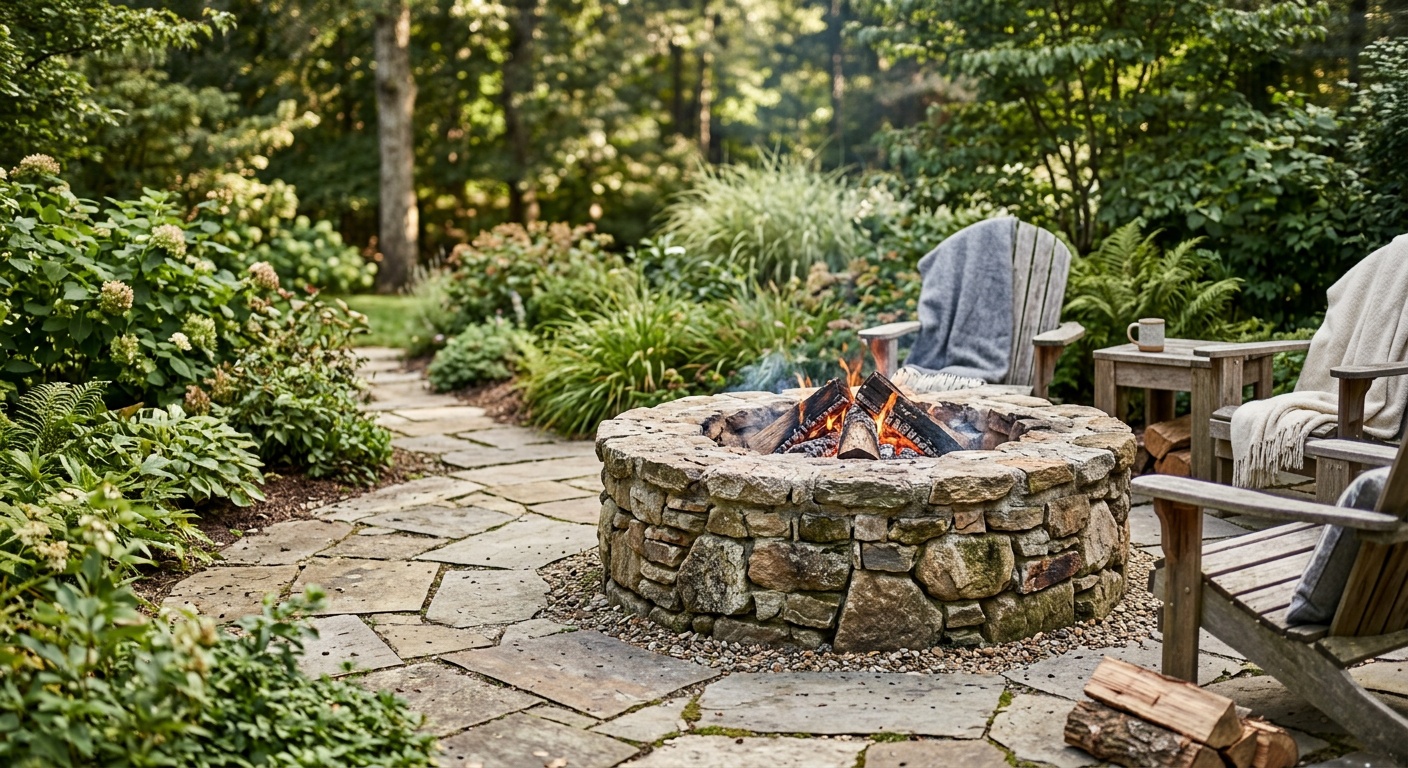
Decorative accent walls, by contrast, are freestanding structures that define spaces, create visual backdrops, or provide seating. A curved stone wall surrounding a fire pit seating area is a classic example. These are generally simpler to permit and build, though they still require solid footings (typically 6–12 inches of compacted gravel base) to prevent settling and movement over time.
Popular stone wall styles trending in 2026 include:
- Stacked ledgestone veneer — clean horizontal lines, works beautifully in modern and transitional designs
- Fieldstone boulder walls — large, irregular natural stones for a rugged, organic look
- Cut granite or bluestone — precise, geometric, perfect for contemporary yards
- Reclaimed brick integrated with stone — warm, textural contrast popular in urban gardens
- Gabion walls (wire cages filled with stone) — industrial-modern aesthetic with built-in drainage
Fire Pit Design Ideas for Every Backyard Style
The fire pit market has exploded in sophistication. What was once a simple metal ring in the ground is now a design element as considered as any interior furniture piece. In 2026, homeowners are choosing fire pits that integrate architecturally with the surrounding landscape — not just sit in the middle of a lawn.
In-Ground vs. Above-Ground Fire Pits
In-ground fire pits create a campfire-like experience and a lower visual profile that keeps sightlines open across the yard. They’re dug into the earth (typically 6–12 inches deep), lined with fire-rated materials like refractory brick or heat-resistant concrete, and surrounded by non-combustible materials. The drawback is that they can collect rainwater and require covers or drainage solutions.
Above-ground stone fire pits are the most popular choice for homeowners integrating fire with stone wall designs. They can be built to any height (typical range: 12–24 inches), incorporate seating ledges or cap stones, and create a natural focal point for the seating area. A mortared flagstone or granite-capped circular fire pit wall, 18 inches high and 4–5 feet in interior diameter, is the classic format for a reason — it works in almost every backyard context.
Gas vs. Wood-Burning: The 2026 Landscape
This debate has shifted significantly in recent years. Gas fire pits (natural gas or propane) now account for approximately 58% of new residential fire feature installations according to 2025 Hearth, Patio & Barbecue Association data. The appeal is obvious: instant ignition, adjustable flame, no smoke, no ash cleanup. Many municipalities with air quality regulations (particularly in California and the Mountain West) are actively incentivizing the switch to gas.
That said, wood-burning fire pits still hold a devoted following. The crackling sound, the actual campfire experience, the ability to toast marshmallows on a real flame — these sensory elements are irreplaceable. If you’re building a stone fire pit in an area without restrictive burn ordinances, a wood-burning design remains an authentic, cost-effective choice (no gas line installation required).
Quick scenario: You live in a Denver suburb with occasional burn restriction days. A dual-fuel system — a stone fire pit with a gas burner insert that can be removed to burn wood on unrestricted days — gives you maximum flexibility. These hybrid setups have grown 41% in popularity since 2024 and are worth the modest additional investment.
Comparing Materials: What Works Best in 2026
Material selection is where many backyard projects go wrong. The wrong stone in the wrong climate can crack, spall, or stain within a few seasons. Here’s an honest comparison of the most popular options.
| Material | Best Use | Durability | Cost (per sq ft, 2026) | Maintenance |
|---|---|---|---|---|
| Natural Fieldstone | Decorative walls, fire pit surrounds | Excellent (50+ years) | $15–$35 | Low |
| Bluestone / Slate | Cap stones, patio paving, wall faces | Very Good (30–40 years) | $20–$50 | Low–Medium |
| Granite | High-traffic areas, contemporary designs | Outstanding (75+ years) | $30–$65 | Very Low |
| Manufactured Stone Veneer | Budget-conscious projects, uniform look | Good (20–30 years) | $8–$20 | Medium |
| Lava Rock / Basalt | Fire pit interiors, decorative mulch | Excellent (heat-resistant) | $12–$28 | Very Low |
Important note on fire pit materials: Never use porous stones like river rock, sandstone, or limestone directly inside or immediately adjacent to a fire chamber. These materials can absorb moisture and explode when rapidly heated. Always line fire pit interiors with refractory (fire-rated) brick, fire-rated concrete blocks, or heat-resistant metal inserts.
Integrated Design Combinations That Work
The real magic happens when stone walls and fire pits are designed as a unified system rather than separate elements. Here are three real-world design approaches that have proven highly successful.
Case Study 1: The Sunken Conversation Circle (Pacific Northwest, 2025)
A Seattle-area homeowner worked with a landscape designer to create a sunken seating area — 18 inches below grade — bounded by dry-stacked basalt walls that doubled as seating ledges. A central circular gas fire pit with a 36-inch burner became the focal point. The result was an intimate outdoor “room” that felt completely sheltered from wind despite having no roof. Total project cost: $28,000. The homeowners reported using the space an average of 3–4 times per week during the cooler months, from September through April.
Case Study 2: The Terraced Hillside Transformation (Austin, Texas, 2025)
A sloped backyard in Austin was transformed using a series of limestone retaining walls creating three distinct terraced levels. The uppermost terrace featured a rectangular wood-burning fire pit with an integrated stone bench wall on three sides. The warm honey tones of Texas limestone complemented the native plantings on each terrace. Rather than fighting the slope, the design made it the star of the project. Estimated ROI: 72% at the home’s subsequent sale in early 2026.
Case Study 3: The Modern Minimalist Fire Wall (Chicago Suburb, 2026)
For a contemporary home with a flat rectangular yard, a designer created a striking linear fire feature: a long, low wall of cut concrete block veneered with charcoal-gray quartzite, with a 6-foot-long linear gas burner embedded in the top surface. The wall served simultaneously as a fire feature, a privacy screen, and a dramatic visual backdrop to the patio seating area. This “fire table wall” concept has surged in popularity in 2026, particularly in newer neighborhoods with smaller lot sizes.
Common Challenges and How to Overcome Them
Every backyard project has its hurdles. Here are the three most common challenges homeowners encounter — and how to navigate them strategically.
Challenge 1: Local Permitting and HOA Restrictions
Building regulations for fire features vary wildly by municipality. As of 2026, many jurisdictions require permits for permanent fire pit structures and have specific setback requirements (typically 10–25 feet from structures and property lines). HOAs add another layer — some prohibit open flame features entirely. Solution: Before any design work begins, contact your local building department and HOA. This takes one afternoon and can save thousands in redesign costs. Gas fire features with automatic shutoffs are approved in a broader range of jurisdictions than wood-burning ones.
Challenge 2: Drainage and Frost Heave
In cold climates (USDA Hardiness Zones 1–6), soil freezing and thawing cycles can shift and topple stone walls within 2–3 seasons if foundations aren’t properly designed. Solution: All stone walls should be built on a gravel base that extends below the frost line. In Zone 5 (Chicago, for example), that means a compacted gravel base starting at 36 inches below grade. For mortared walls, drainage is equally critical — waterlogged soil becomes ice, which exerts enormous lateral force. Install perforated drain pipe and gravel backfill behind any retaining wall.
Challenge 3: Budget Scope Creep
Stone work is labor-intensive, and costs can escalate quickly. The 2025 National Landscape Association survey found that 67% of homeowners spent more than their initial budget on stone and hardscape projects. Solution: Design in phases. Install the fire pit and primary stone wall in year one; add secondary walls, lighting, and plantings in year two. Also, consider manufactured stone veneer over a concrete block core for secondary walls where aesthetics are important but budget is tight — the visual result can be remarkably similar at 40–60% of the natural stone cost.
2026 Backyard Feature Popularity: What Homeowners Are Building
Based on 2025 ASLA survey data of 3,200 U.S. homeowners who completed outdoor projects in the past 18 months:
Source: American Society of Landscape Architects, 2025 Residential Landscape Survey (n=3,200)
Frequently Asked Questions
How far should a stone fire pit be from a stone wall or fence?
The general rule is a minimum of 10 feet clearance from any combustible structure, including wooden fences, pergolas, and the home itself. However, stone walls are non-combustible, so a stone seating wall can be positioned much closer — typically 3–5 feet from the fire pit edge is comfortable for both safety and conversational gathering. Always verify your local fire code, as some municipalities have stricter requirements, particularly in fire-risk zones in western states. The fire pit should also be positioned so prevailing winds carry smoke away from the seating area and any combustible structures.
Can I build a stone wall and fire pit myself, or do I need a professional?
Honestly, it depends on the scope. A simple dry-stack decorative wall under 18 inches and a basic above-ground stone fire pit are within reach for a motivated DIYer with some masonry experience — budget roughly $800–$2,500 in materials and a few weekends. However, anything involving retaining walls over 2 feet, gas line connections, significant grading changes, or mortared construction really warrants professional involvement. The structural risks of a poorly built retaining wall (collapse, injury) and the safety risks of incorrect gas connections are simply too significant. A middle path: hire a professional for the structural elements and do the decorative finishing work yourself.
What is the average cost of a complete stone wall and fire pit backyard project in 2026?
Costs vary enormously based on scale, materials, and regional labor rates. In 2026, a modest integrated project — a circular stone fire pit with an 8-foot-diameter seating wall — typically runs $4,000–$8,000 installed with natural stone. A mid-range project with terraced retaining walls, a gas fire pit, integrated lighting, and stone cap seating runs $15,000–$35,000. High-end, custom-designed outdoor living spaces with premium stone, built-in seating, gas fire features, and professional landscape design can range from $40,000 to well over $100,000. Labor typically accounts for 50–65% of total project cost, so material upgrades have a smaller proportional impact on the overall budget than most homeowners expect.
Build Your Dream Backyard: Your Action Plan
The convergence of outdoor living culture, rising home values, and increasingly sophisticated design options makes 2026 an exceptional moment to invest in a stone wall and fire pit project. The question isn’t really whether you should do it — it’s how to do it right.
Here’s your practical roadmap for moving from inspiration to reality:
- Start with function, not aesthetics. Before choosing your stone type or fire pit style, define how you want to use the space. Entertainment for large groups? Intimate family evenings? A quiet reading nook with ambient fire? The function drives every design decision that follows.
- Check your local requirements early. Call your municipal building department and your HOA (if applicable) within the first week of planning. Understand permit requirements, setback rules, and any open-burn restrictions for your area. This is a one-hour task that can reshape your entire design approach.
- Choose your materials based on your climate zone first, aesthetics second. A stunning sandstone wall in Zone 4 is a maintenance nightmare. Match material durability to your climate reality before falling in love with a look.
- Design for integration. Resist the urge to treat the fire pit and walls as separate elements. Sketch them together from the beginning. The most stunning results come from designs where every element references and complements the others.
- Phase your project if budget is a constraint. Build the structural elements (retaining walls, fire pit base) first. Add decorative walls, lighting, plantings, and accessories in subsequent seasons as budget allows.
As urban yards shrink and the desire for meaningful at-home experiences continues to grow in the post-2024 cultural moment, the outdoor living space is rapidly becoming the most important room in the house. Stone walls and fire pits are foundational to that shift — connecting us to elemental experiences of warmth, community, and natural materials in ways that no screen or interior renovation can replicate.
So here’s the question worth sitting with: What kind of evenings do you want to be having in your backyard one year from now? Because the project you start planning today can make that vision a reality by next autumn — and keep delivering value for decades to come.
Article reviewed by Gary Kowalski, Structural Demolition & Load-Bearing Analysis Expert, on July 15, 2026