Home Renovation Grants for Seniors Upgrading Outdoor Spaces: Your Complete 2026 Guide
Reading time: 14 minutes
Your backyard shouldn’t feel like a barrier. For millions of older adults across the United States, what was once a beloved garden patio or front walkway has quietly become a source of anxiety — uneven pavers, steep steps, no handrails, poor lighting. The outdoor space that used to host family barbecues now feels off-limits after dark or on rainy days.
Here’s the good news: you don’t have to navigate this challenge alone, and you certainly don’t have to fund every upgrade out of pocket. In 2026, a robust landscape of federal, state, nonprofit, and private grants exists specifically to help seniors modernize and make safe their outdoor living spaces. The challenge — and this is where most people get stuck — is knowing where to look, what you qualify for, and how to apply strategically.
This guide cuts through the bureaucratic fog and gives you a clear, actionable roadmap to securing funding for outdoor renovations that improve safety, independence, and quality of life.
Table of Contents
- Why Outdoor Spaces Matter More Than You Think
- The 2026 Grant Landscape: What’s Available
- Federal Programs Worth Knowing
- State and Local Funding Opportunities
- Nonprofit and Private Grant Sources
- Understanding Eligibility: Who Qualifies?
- How to Apply: A Step-by-Step Strategy
- Real-World Examples: Seniors Who Got Funded
- Common Challenges and How to Overcome Them
- Grant Program Comparison Table
- Funding Distribution: Where the Money Goes
- Frequently Asked Questions
- Your Action Plan: Making It Happen This Year
Why Outdoor Spaces Matter More Than You Think
Before diving into grant specifics, let’s establish something important: outdoor renovation for seniors isn’t a luxury. It’s a health and safety necessity backed by solid data.
According to the Centers for Disease Control and Prevention (CDC), falls are the leading cause of injury-related death among adults aged 65 and older. In 2025, approximately 36,000 older adults died as a result of falls, with a significant proportion occurring in outdoor settings — driveways, walkways, steps, and decks. Uneven surfaces, slippery pavers, and inadequate lighting are among the most cited environmental contributors.
Beyond safety, outdoor access directly correlates with mental health. A 2025 study published in the Journal of Aging and Environment found that seniors with accessible outdoor spaces reported 34% lower rates of depression and 28% higher levels of daily physical activity compared to those without reliable outdoor access. These aren’t marginal improvements — they’re life-changing differences.
Common outdoor upgrades that make a measurable difference include:
- Slip-resistant pathway surfacing and walkway widening
- Ramp installation to replace or supplement stairs
- Grab bars and handrails on steps, decks, and porches
- Improved outdoor lighting with motion sensors
- Raised garden beds for accessible horticulture
- Weatherproof seating areas with shade structures
- Level transition zones between interior and exterior spaces
The financial reality? These upgrades can range from a few hundred dollars (basic handrails) to $15,000 or more (full ramp installation and deck reconstruction). That’s why grant funding isn’t just helpful — for many fixed-income seniors, it’s essential.
The 2026 Grant Landscape: What’s Available
The funding environment in 2026 is arguably the most robust it has ever been for senior home modification. Several factors have converged to create this opportunity:
First, the aging Baby Boomer population has reached a critical mass. By 2026, approximately 73 million Americans are aged 60 or older, creating enormous political and policy pressure to address aging-in-place infrastructure.
Second, the continued implementation of the Older Americans Act Reauthorization, combined with post-pandemic housing equity funding streams, has kept federal appropriations for senior housing modification at historically high levels through 2026 and projected into 2027.
Third, state governments — particularly in aging-heavy states like Florida, Pennsylvania, Arizona, and Maine — have introduced or expanded their own senior home modification grant programs in response to both resident demand and Medicaid cost-reduction incentives (keeping seniors at home costs far less than institutional care).
The result: a layered funding ecosystem where a strategic senior can potentially access multiple simultaneous grants from different sources — federal, state, local, and nonprofit — to cover the full cost of an outdoor renovation project.
Federal Programs Worth Knowing
USDA Section 504 Home Repair Program
This is one of the most powerful and underutilized federal programs available to rural seniors. The USDA Section 504 Home Repair Program (also called the Very Low-Income Housing Repair Program) provides grants of up to $10,000 specifically to homeowners aged 62 and older in rural areas who cannot afford safe, decent housing.
Crucially, outdoor modifications — including accessibility ramps, walkway repairs, and outdoor safety improvements — are explicitly eligible expenditures. The program is grant-based (not a loan) for seniors who qualify on income grounds, meaning there’s no repayment obligation.
Eligibility basics: You must own and occupy the property, be located in an eligible rural area (check the USDA eligibility map at usda.gov), and have a household income at or below 50% of the area median income. In 2026, the program continues to operate through local USDA Rural Development offices with applications accepted on a rolling basis.
HUD Community Development Block Grants (CDBG)
The Community Development Block Grant program administered by the U.S. Department of Housing and Urban Development (HUD) is a flexible federal funding mechanism that flows to states, counties, and cities. Local governments then deploy these funds through their own home repair and modification programs — many of which specifically target low-to-moderate-income seniors.
Because CDBG funds are locally administered, the specific programs available vary significantly by location. Your city or county’s housing department is the right first call. In 2026, CDBG appropriations stand at approximately $3.3 billion nationally, with meaningful allocations flowing to senior modification programs in most major metropolitan areas and many rural counties.
Administration for Community Living (ACL) Programs
The ACL, operating under the Department of Health and Human Services, funds a network of Area Agencies on Aging (AAAs) that in turn fund local service providers — including home modification assistance programs. Through the Older Americans Act Title III-B funding stream, AAAs can direct resources toward supportive services including home modification.
The ACL’s Older Adults Home Modification Program — funded through a separate competitive grant stream — provided over $50 million in 2025 to community organizations delivering modification services directly to seniors. For 2026, similar appropriation levels are maintained. To access these services, contact your local AAA through the Eldercare Locator (eldercare.acl.gov or 1-800-677-1116).
State and Local Funding Opportunities
State-Level Home Modification Programs
Beyond federal programs, many states have created their own grant and low-interest loan programs for senior home modification. Here are several standout examples active in 2026:
California’s Home Modification Loan Program (HMLP): Administered by the California Department of Aging, this program provides deferred-payment loans up to $20,000 for low-income seniors and persons with disabilities. While technically a loan, repayment is deferred until the property is sold or transferred — functioning much like a grant for most participants.
Pennsylvania’s Weatherization and Home Modification Program: Pennsylvania’s PHFA (Pennsylvania Housing Finance Agency) runs robust senior modification assistance that includes outdoor accessibility improvements. In 2025, the program served over 8,400 seniors statewide.
Texas’s Home Repair Assistance Program: The Texas Department of Housing and Community Affairs (TDHCA) administers this program, targeting low-income seniors with grants for health and safety improvements including outdoor accessibility modifications.
Maine’s Home Modification Program: Maine’s Office of Aging and Disability Services coordinates with local Community Action Agencies to provide grants for senior home modification, with outdoor safety improvements as a covered category.
Don’t overlook your county or municipality either. Many local governments — particularly in areas with significant senior populations — run their own modification grant programs funded by a mix of local tax revenues, state pass-through funds, and federal CDBG dollars.
Nonprofit and Private Grant Sources
The nonprofit sector rounds out a powerful funding picture for seniors seeking outdoor renovation support. These organizations often have simpler application processes and faster turnaround than government programs.
Rebuilding Together: This national nonprofit with over 150 local affiliates provides free home repair and modification services to low-income homeowners, with a specific focus on seniors and people with disabilities. Their Safe at Home initiative prioritizes fall prevention modifications — directly applicable to outdoor spaces. In 2025, Rebuilding Together served more than 100,000 homeowners nationwide.
Habitat for Humanity’s Home Repair Program: Often overlooked, Habitat for Humanity affiliates operate home repair programs (distinct from their new construction work) that can fund outdoor accessibility improvements. Availability varies by local affiliate.
National Aging in Place Council (NAIPC): While primarily a membership and advocacy organization, NAIPC maintains connections to funding resources and can direct seniors to local funding sources through their network.
AARP Foundation: AARP Foundation’s HomeFit and related initiatives connect seniors with local modification resources. While AARP Foundation doesn’t typically grant money directly to individuals, their network can unlock access to programs that do.
Veterans-Specific Programs: For senior veterans, the Department of Veterans Affairs offers two powerful programs — the Specially Adapted Housing (SAH) Grant (up to $109,986 in 2026) and the Special Home Adaptation (SHA) Grant (up to $22,036 in 2026) — for veterans with qualifying service-connected disabilities. These can fund significant outdoor modifications.
Understanding Eligibility: Who Qualifies?
Here’s the straight talk: eligibility requirements vary substantially across programs, but most share a core set of factors. Understanding these upfront saves time and frustration.
Age: Most senior-specific programs require applicants to be 60, 62, or 65 and older. The specific threshold matters — a 61-year-old might qualify for some programs but not others.
Income: The majority of grant programs target low-to-moderate income seniors. Income thresholds are typically expressed as a percentage of the Area Median Income (AMI) — 50% AMI (very low income) and 80% AMI (low-to-moderate income) are the most common cutoffs. In 2026, for a single-person household, 50% AMI in many U.S. metropolitan areas falls in the $28,000–$45,000 range annually.
Homeownership: Nearly all programs require the applicant to own (not rent) the home being modified. Some programs also require that the home be the primary residence.
Property condition and type: Most programs have limitations on property type (single-family homes are most commonly covered; condos and manufactured homes may have different rules).
Scope of work: Grants are typically tied to specific eligible modification categories. Outdoor accessibility and safety improvements are broadly covered, but cosmetic enhancements (like decorative landscaping) generally are not.
Pro Tip: Don’t self-disqualify before applying. Many seniors assume they won’t qualify based on income and don’t bother applying — only to discover later that the income thresholds were higher than they expected, or that asset tests didn’t apply to their situation. When in doubt, apply and let the program determine eligibility.
How to Apply: A Step-by-Step Strategy
Successful grant applications aren’t about luck — they’re about preparation and strategic sequencing. Here’s a practical roadmap:
- Conduct a needs assessment first. Before applying anywhere, get a professional home modification assessment. Many local AAAs and nonprofits offer these free of charge. A written assessment from a certified aging-in-place specialist (CAPS) strengthens every application you submit.
- Contact your local Area Agency on Aging. This is your single most important first call. AAA staff know the local funding landscape better than anyone. They can tell you which programs are currently accepting applications, which have waitlists, and how to prioritize your applications. Find yours at eldercare.acl.gov.
- Gather your documentation package early. Most programs require: proof of age (birth certificate or driver’s license), proof of income (tax returns, Social Security award letters, pension statements), proof of homeownership (deed or mortgage statement), and proof of primary residency. Having these ready in a folder saves significant time.
- Apply to multiple programs simultaneously. There’s no rule against receiving funding from multiple sources as long as combined grants don’t exceed total project costs. Stack federal, state, and nonprofit sources strategically.
- Get multiple contractor quotes. Many programs require competitive bidding for projects above a certain cost threshold. Having three quotes ready also demonstrates due diligence to grant reviewers.
- Follow up consistently. Grant applications don’t manage themselves. Keep a log of each application, submission date, and expected response timeline. Follow up proactively but professionally.
Real-World Examples: Seniors Who Got Funded
Margaret’s Transformation in Rural Ohio
Margaret, 74, lives alone in a farmhouse outside of Chillicothe, Ohio. Her front porch steps — four wooden steps with a single wobbly railing — had become a source of daily anxiety. After a near-fall in the autumn of 2024, her daughter urged her to explore grant options.
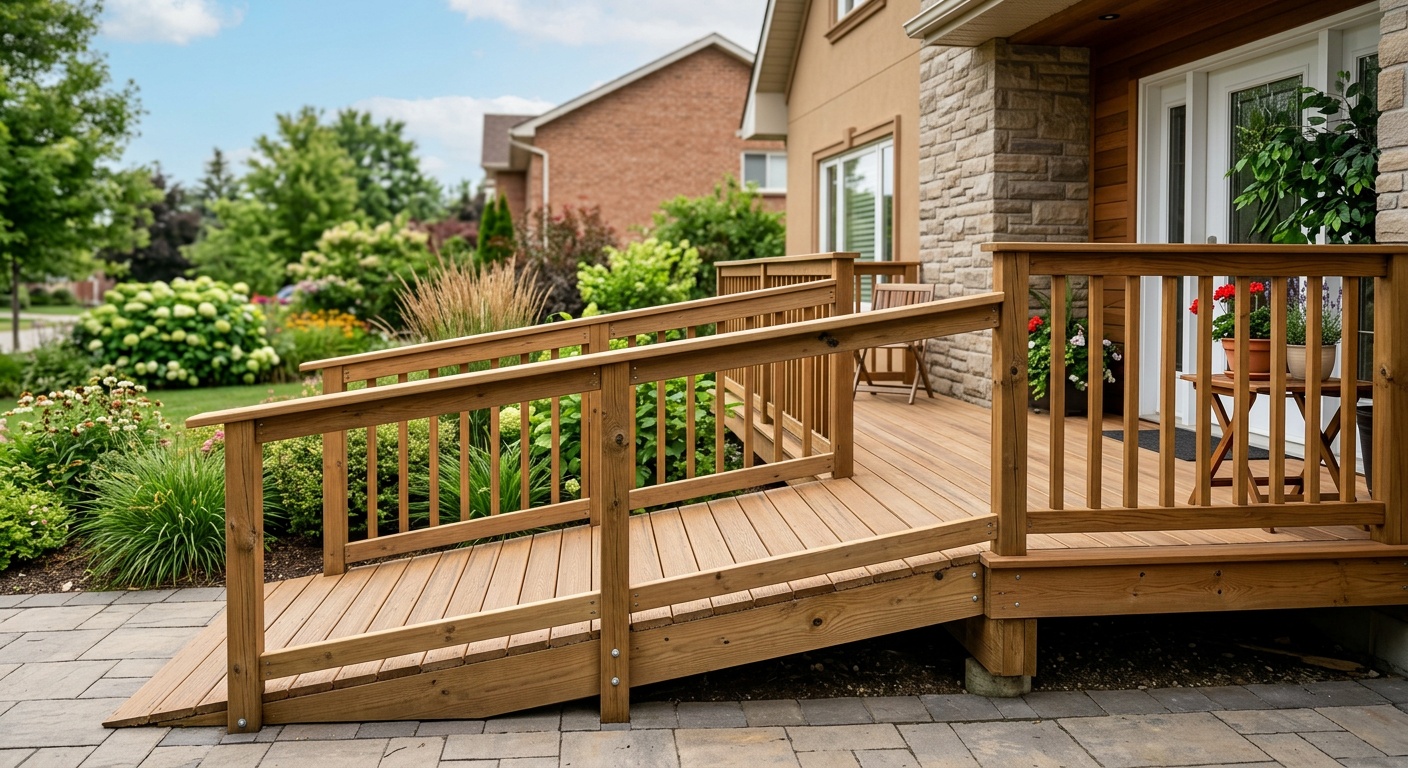
Through her local AAA, Margaret learned about the USDA Section 504 program. Her annual income of $16,800 (Social Security plus a small pension) qualified her at well under 50% of the area median income. She applied in January 2025 and received a grant determination of $8,400 within six weeks. The funds covered a full wooden ramp installation with handrails on both sides, slip-resistant porch surfacing, improved outdoor lighting with motion sensors, and a widened pathway from the driveway to the ramp.
Margaret now gardens daily and hosts her grandchildren on weekends. “I feel like I got my house back,” she told her case worker.
Robert and Elaine’s Multi-Source Strategy in Phoenix
Robert (71) and Elaine (68) own a 1980s ranch-style home in Phoenix, Arizona. Their backyard — once the social heart of the family — had become inaccessible after Robert’s knee replacement in 2024 left him with significant mobility limitations. The project they needed was substantial: replacing broken pavers, installing a covered shade structure with seating, adding a concrete pathway to the back fence, and installing exterior grab bars on the sliding door exit.
Total project quotes came in around $14,000 — well beyond their fixed income budget. Working with an AARP Foundation HomeFit advisor, they pursued a layered approach:
- Arizona’s CDBG-funded Maricopa County Home Repair Program: $6,500
- Local Rebuilding Together affiliate (volunteer labor and materials): valued at $3,800
- A faith-based community grant through their church’s senior outreach fund: $2,000
Total out-of-pocket cost: $1,700. The project was completed in spring 2026. Robert now uses the backyard daily for physical therapy exercises, and the family hosts monthly gatherings again.
Common Challenges and How to Overcome Them
Challenge 1: Long waitlists. Popular programs — especially USDA Section 504 and some state-level programs — can have waitlists of several months to over a year in high-demand areas. Solution: Apply to multiple programs simultaneously so that when one comes through, you’re positioned to move quickly. Also ask your AAA about emergency modification funds for urgent safety hazards, which sometimes bypass standard waitlists.
Challenge 2: Documentation complexity. The paperwork required for some programs can be overwhelming, particularly for seniors who aren’t comfortable with bureaucratic processes. Solution: Don’t go it alone. Local AAAs, SHIP (State Health Insurance Assistance Program) counselors, and nonprofit housing counselors can assist with applications at no charge. Many libraries also offer assistance during senior resource days.
Challenge 3: Contractor availability and compliance. Many grant programs require that work be performed by contractors who are pre-approved, licensed, and insured — and who are willing to comply with program payment timelines (which can be slower than private-pay projects). Solution: Ask your AAA or grant administrator for a list of pre-approved contractors familiar with the program. These contractors understand the billing process and won’t be surprised by program timelines.
Grant Program Comparison Table
| Program | Max Grant Amount | Age Requirement | Income Threshold | Geographic Scope |
|---|---|---|---|---|
| USDA Section 504 | $10,000 | 62+ | ≤50% AMI | Rural areas only |
| HUD CDBG (local programs) | Varies ($5,000–$25,000) | 55–62+ (varies) | ≤80% AMI | Most US cities/counties |
| VA SAH/SHA Grant | Up to $109,986 (SAH) | No age minimum | No income test | National (veterans only) |
| Rebuilding Together | In-kind services (varies) | 60+ preferred | Low income | 150+ US affiliates |
| State-Level Programs (e.g., CA HMLP) | Up to $20,000 | 60–65+ (varies) | ≤80% AMI (varies) | State-specific |
Funding Distribution: Where the Money Goes
Based on 2025 data from the Administration for Community Living, here’s how senior home modification grant funding is typically allocated across project categories — including outdoor spaces:
Senior Home Modification Grant Allocations (2025 National Data)
Source: ACL Senior Home Modification Program Data, 2025
What’s notable here: outdoor accessibility modifications — at 27% of all funded work — represent the second-largest category. This reflects both the safety imperative and the increasing recognition among program administrators that outdoor access is integral to aging-in-place success.
Frequently Asked Questions
Can I receive grants from multiple programs at the same time?
Yes, in most cases you can receive funding from multiple grant sources simultaneously, provided the combined funding does not exceed your total documented project costs. This is sometimes called “grant stacking” and is both legal and encouraged by program administrators who understand that individual grants often don’t cover the full scope of needed modifications. Be transparent with each program about other funding you are seeking or have received — most programs have a coordination of benefits question in their applications, and honesty here is both ethically important and practically required.
What if my income is too high for income-based programs?
Don’t give up — several options remain available. First, verify the income threshold carefully; many seniors are surprised to find they fall within program limits, particularly after allowable deductions. Second, explore programs that don’t have income tests, such as the VA grants for eligible veterans. Third, consider low-interest loan programs (like state housing agency deferred-payment loans) that function similarly to grants for most homeowners. Finally, look into tax incentives: the federal medical expense deduction may allow you to deduct accessibility modification costs as medical expenses if a physician can document medical necessity — consult a tax advisor about your specific situation.
How long does it typically take to receive grant funding after applying?
Timeline varies significantly by program. USDA Section 504 decisions often come within 60–90 days in areas without long waitlists, but can take 6–12 months or longer in high-demand rural areas. HUD CDBG-funded local programs vary enormously — some process applications within 30 days, others have six-month waitlists. Nonprofit programs like Rebuilding Together typically operate on project scheduling cycles and may schedule work within weeks of intake, but availability depends on local affiliate capacity and season. The practical advice: apply early, apply to multiple programs, and stay in contact with your program caseworker throughout the process.
Your Action Plan: Making It Happen This Year
The funding exists. The programs are running. The only thing standing between you and a safer, more accessible outdoor space is taking the first step. Here’s your concrete action plan for 2026:
- Week 1: Call the Eldercare Locator (1-800-677-1116) or visit eldercare.acl.gov to identify your local Area Agency on Aging. Request an intake conversation and ask specifically about home modification grant programs in your area.
- Week 2: Gather your documentation packet — proof of age, income documents (last two years of tax returns, all Social Security and pension award letters), deed or mortgage statement, and utility bills confirming primary residency.
- Week 3: Schedule a free home modification assessment through your AAA or a local nonprofit. Request a written report suitable for inclusion in grant applications.
- Weeks 4–6: Submit applications to the top two or three programs identified by your AAA as best matches for your situation. Keep copies of everything.
- Ongoing: Follow up monthly, explore supplementary nonprofit sources (Rebuilding Together, local faith communities, civic organizations), and don’t hesitate to ask for help navigating paperwork.
As America continues to age — with the oldest Baby Boomers now in their late 70s and the demographic wave showing no signs of slowing — the political and funding momentum behind aging-in-place initiatives is only going to grow through 2027 and beyond. The investment being made now in senior home modification isn’t just compassionate policy; it’s economically rational, reducing hospitalizations, preventing institutionalization, and preserving community ties.
You’ve built your home into a life. You’ve earned the right to stay in it, safely and comfortably, on your own terms. The grants described in this guide exist precisely to support that goal — and the right moment to pursue them is now.
What would change in your daily life if your outdoor space was fully safe and accessible? That vision is worth the application process.
Article reviewed by Gary Kowalski, Structural Demolition & Load-Bearing Analysis Expert, on July 15, 2026