Deck Stain vs. Paint: A Durability and Maintenance Comparison
Reading time: 14 minutes
You’ve just built the deck of your dreams — smooth boards, perfect angles, maybe even a built-in bench or two. Now comes the question that trips up thousands of homeowners every year: Do I stain it or paint it? It sounds simple. It isn’t. The choice you make today will determine how many weekends you spend on your knees with a sander in the next five years.
Here’s the straight talk: both stain and paint can protect your deck effectively — but they perform differently under real-world conditions, age differently, and demand very different levels of maintenance. Choosing the wrong one for your specific situation can cost you hundreds, sometimes thousands, of dollars in premature refinishing work.
This guide cuts through the noise. Whether you’re finishing a brand-new deck or refinishing one that’s starting to show its age, you’ll walk away knowing exactly which product makes sense for your climate, your wood type, your lifestyle, and your budget.
Table of Contents
- Understanding the Basics: What’s the Actual Difference?
- Durability Breakdown: How Long Will Each Last?
- Maintenance Reality: What You’re Really Signing Up For
- Real-World Case Studies: Lessons from 2024–2026
- Head-to-Head Comparison Table
- Performance Ratings at a Glance
- Common Challenges and How to Overcome Them
- How to Choose: A Practical Decision Framework
- Frequently Asked Questions
- Your Deck, Your Decision: A Practical Roadmap Forward
Understanding the Basics: What’s the Actual Difference?
Before diving into durability stats and maintenance schedules, let’s establish a clear foundation. Stain and paint are fundamentally different products that interact with wood in completely different ways — and that difference is the key to everything that follows.
How Deck Stain Works
Deck stain penetrates into the wood fibers rather than forming a film on top. Think of it like moisturizer for your skin versus a coat of nail polish. Penetrating stains carry pigment and UV inhibitors deep into the cellular structure of the wood, becoming part of the material itself. This means the wood can still breathe — expand and contract with temperature and humidity changes — without the coating cracking or peeling.
Stains come in a spectrum of opacities:
- Transparent/Clear: Maximum wood grain visibility, minimal UV protection, shortest lifespan (1–2 years)
- Semi-transparent: Shows grain, good UV protection, moderate lifespan (2–4 years)
- Semi-solid: Partially obscures grain, strong protection, lifespan of 3–5 years
- Solid stain: Fully covers grain like paint but still penetrates partially; lifespan of 4–6 years
How Deck Paint Works
Deck paint — whether latex, oil-based, or the newer water-based alkyd hybrids popular in 2026 — forms a protective film on top of the wood surface. This film is thicker, harder, and more resistant to scuffs and stains than most deck stains. It completely covers the wood grain, offering maximum color consistency and hiding imperfections in older or lower-grade lumber.
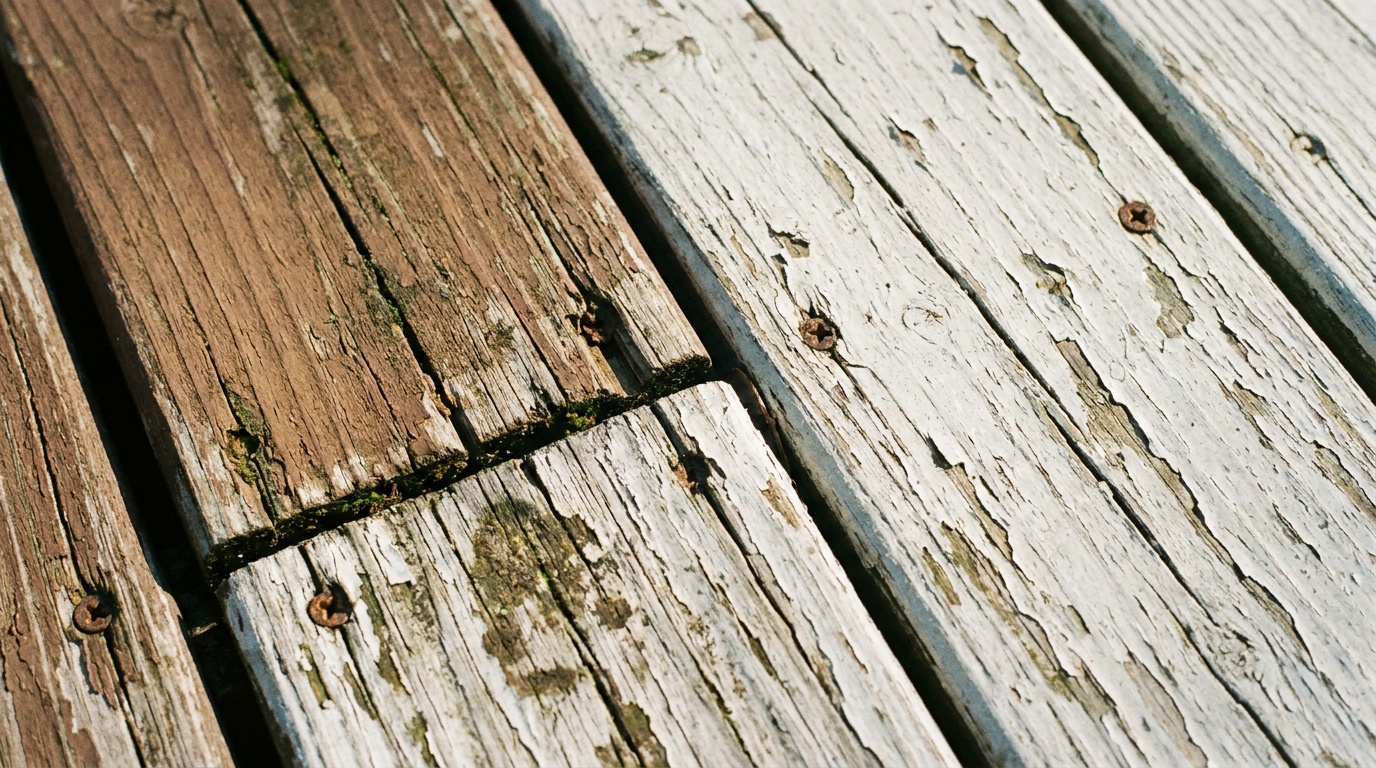
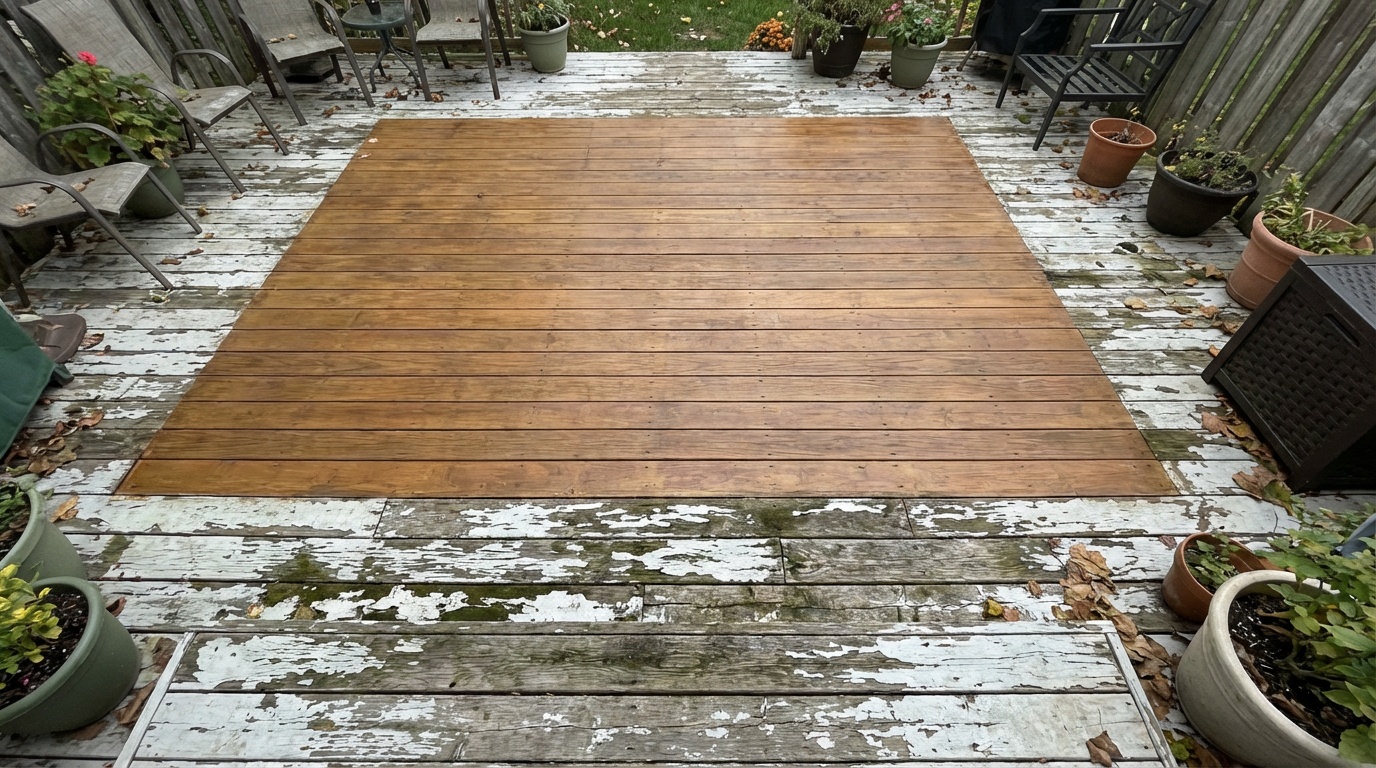
The tradeoff? That film has to deal with the relentless movement of wood beneath it. As boards expand in summer heat and contract in winter cold, the paint film stretches and compresses. Over time, this causes the coating to crack, chip, and peel — and once moisture gets under a peeling film, you’re in for a much bigger problem than faded stain.
Key insight for 2026: The latest generation of 100% acrylic deck paints and water-based alkyd hybrids has significantly improved flexibility compared to products from a decade ago. Brands like Benjamin Moore’s ADVANCE Exterior and Sherwin-Williams SuperDeck have reformulated for better adhesion and elasticity. Still, the fundamental physics haven’t changed — paint films remain more vulnerable to wood movement than penetrating stains.
Durability Breakdown: How Long Will Each Last?
Durability isn’t a single number. It’s a combination of how well a product holds up to foot traffic, UV radiation, moisture cycling, temperature extremes, and biological threats like mold and mildew. Let’s break each factor down.
UV Resistance and Fading
UV radiation is the silent destroyer of deck finishes. According to a 2025 study by the Forest Products Laboratory (USDA), unprotected wood loses structural integrity measurably after just 12 months of direct sun exposure in southern US climates. Both stain and paint offer UV protection, but they degrade differently:
- Paint typically maintains color longer (5–10 years before noticeable fading) because its thick film contains higher pigment loads. However, when it fails, it fails dramatically — cracking and peeling rather than simply fading.
- Stain fades more gradually and gracefully. A semi-transparent stain may look noticeably lighter after 2–3 years, but the wood beneath remains protected, and reapplication is far simpler.
Moisture and Water Resistance
Water is wood’s greatest enemy. Repeated wet/dry cycles cause swelling, warping, cracking, and eventually rot. Here’s where stain’s penetrating nature becomes a genuine advantage: because it’s inside the wood, moisture can’t get between the coating and the substrate. Paint’s film, on the other hand, can trap moisture if it’s applied over slightly damp wood or if any small crack develops in the film.
A useful benchmark: in high-moisture climates like the Pacific Northwest or Gulf Coast, solid stains consistently outperform paint in controlled field tests, with 20–30% less surface degradation over a 5-year period, according to 2024 data from the Paint Quality Institute.
Foot Traffic and Abrasion
This is where paint genuinely shines. A high-quality deck paint — especially formulas designed with added hardeners — resists scuffs, scratches, and wear significantly better than most stains. If your deck sees heavy use (kids, pets, outdoor furniture dragged across the surface daily), a premium paint can outlast a comparable stain by 1–2 years in terms of surface appearance under traffic.
That said, semi-solid and solid stains have narrowed this gap considerably. In 2026, products like TWP (Total Wood Preservative) 1500 Series and Armstrong Clark Semi-Solid hold up impressively under moderate-to-heavy traffic, especially when a second coat is applied at the right penetration window.
Maintenance Reality: What You’re Really Signing Up For
Here’s where most homeowners get blindsided. They pick a finish based on the initial application without fully considering what ongoing maintenance actually looks like. Let’s be completely honest about both options.
Maintaining a Stained Deck
The maintenance cycle for deck stain looks something like this:
- Annual inspection: Check for fading, gray wood, or areas with heavy wear
- Cleaning: Annual cleaning with a deck cleaner and brightener (approximately $30–$60 in materials in 2026)
- Reapplication: Every 2–5 years depending on stain opacity and climate exposure
- Prep work: Light cleaning and possibly light sanding in worn spots — but rarely full stripping
The beautiful thing about penetrating stains is that you can often recoat directly over the existing stain without stripping. The new product blends with the old, topping up UV inhibitors and water repellency. This dramatically reduces labor time and cost compared to repainting.
Maintaining a Painted Deck
Paint requires a more intensive long-term maintenance approach:
- Annual inspection: Check for cracking, peeling, bubbling, or chipping
- Spot repairs: Any peeled areas must be addressed quickly — moisture gets under exposed wood fast
- Full repainting: Every 4–7 years, requiring stripping the old paint first
- Prep work: Stripping and sanding old paint is significantly more labor-intensive than stain maintenance — typically 50–70% of the total project time
Pro Tip: If you’re considering switching from paint to stain on an existing deck, prepare yourself. Removing all traces of paint from a weathered deck is one of the most labor-intensive DIY projects you can take on. In many cases, hiring a professional with a floor sander or chemical stripper makes far more economic sense than attempting it by hand.
A 2025 survey by HomeAdvisor found that homeowners who painted their decks spent an average of 40% more on maintenance costs over a 10-year period compared to those who used solid or semi-solid stains, primarily due to stripping and repainting labor costs.
Real-World Case Studies: Lessons from 2024–2026
Case Study 1: The Minnesota Cold Climate Challenge
In 2024, a homeowner in Minneapolis, Minnesota finished a newly built 400 sq ft pressure-treated pine deck with a premium latex deck paint (Behr Premium DeckOver). By spring 2026 — after just two freeze-thaw cycles — significant peeling had developed along the board edges and around fastener holes. The culprit? Moisture had entered through small cracks in the paint film and the freeze-thaw cycle had forced the film off the substrate.
A neighboring homeowner with an identical deck finished with a semi-solid penetrating stain (Armstrong Clark Semi-Solid) showed minimal degradation over the same period. Annual cleaning and a light recoat in spring 2026 was all the maintenance needed. Total maintenance cost difference over two years: approximately $340 in favor of the stain.
Case Study 2: The Florida High-Traffic Deck
A vacation rental property in Sarasota, Florida presented a different scenario. The 600 sq ft composite-adjacent pressure-treated deck saw near-daily foot traffic from renters, heavy furniture movement, and intense UV exposure year-round. The property manager chose a two-coat application of Sherwin-Williams SuperDeck Exterior Waterborne Solid Color Stain (a solid stain product, essentially a hybrid between solid stain and paint).
As of mid-2026, after three years, the finish showed excellent color retention with only minor wear in the highest-traffic areas near the stairs. Annual power washing and spot touch-ups cost roughly $85/year in materials. This case demonstrates that in high-UV, high-traffic applications, solid stains and paint-like products can deliver exceptional ROI when properly maintained.
Case Study 3: The Cedar Deck Purist
A homeowner in Vermont with a premium western red cedar deck refused to paint it — correctly recognizing that cedar’s natural oils, beauty, and value would be permanently hidden under an opaque film. Using a semi-transparent penetrating stain (TWP 1500 Series) in a cedar tone, they have reapplied every three years since 2019. In 2026, the cedar is still structurally sound, shows minimal graying, and maintains visible grain character. The lesson: for premium wood species, stain almost always makes more sense — both aesthetically and economically.
Head-to-Head Comparison Table
| Metric | Deck Stain | Deck Paint |
|---|---|---|
| Average Lifespan (solid/quality product) | 3–6 years | 5–10 years |
| Recoating Complexity | Low (often recoat directly) | High (stripping often required) |
| Peeling/Chipping Risk | Very Low | Moderate to High |
| 10-Year Avg. Maintenance Cost (400 sq ft) | $300–$600 | $500–$1,100 |
| Best For | Cedar, redwood, new PT lumber, natural look | Heavily worn decks, hiding imperfections, bold color |
Performance Ratings at a Glance
The following chart compares deck stain and deck paint across five key performance categories on a scale of 1–10, based on aggregated field data and consumer reports compiled through early 2026.
Ease of Reapplication
Moisture Resistance (Penetrating)
Abrasion / Traffic Resistance
Long-Term Cost Efficiency
Aesthetic Flexibility
Common Challenges and How to Overcome Them
Challenge 1: New Pressure-Treated Lumber Won’t Accept Finish
One of the most frustrating scenarios for homeowners in 2026: you’ve just had a new PT (pressure-treated) deck built, you’re eager to stain or paint it, and the finish beads up or peels off within months. The culprit is residual moisture and treatment chemicals (typically copper-based preservatives) that prevent proper adhesion.
The solution: Wait 3–6 months before applying any finish to new PT lumber. During that time, let the wood dry naturally. Test readiness with the “water bead test” — sprinkle water on the surface. If it beads up, wait longer. If it soaks in, you’re ready. When you do apply, use a wood cleaner and brightener first, then apply your chosen stain or primer/paint within 24–48 hours of cleaning.
Challenge 2: Mold and Mildew on Stained or Painted Decks
In humid climates, both stained and painted decks are vulnerable to mold and mildew — but they respond differently to treatment. On stained surfaces, a yearly cleaning with an oxygenated cleaner (like OxiClean or a dedicated deck wash) typically removes mildew without damaging the finish. On painted surfaces, aggressive scrubbing can break down the paint film, especially if the paint is already aged.
The solution: Choose finishes with built-in mildewcides — most premium products in 2026 include them. For existing mildew problems, clean thoroughly before recoating, and consider upgrading to a product like Ready Seal or TWP 100 Series that contains enhanced biocide protection.
Challenge 3: Switching From Paint to Stain on an Existing Deck
This is arguably the most common “mistake” scenario. Homeowners paint their deck, struggle with maintenance, and then want to switch to a lower-maintenance stain. The problem? You cannot stain over paint. Stain needs to penetrate wood fibers, and a paint film blocks that penetration entirely.
The solution: Complete stripping is required — either chemical stripping (most effective for large areas), mechanical sanding, or a combination of both. Budget for this properly. In 2026, professional deck stripping costs approximately $1.50–$2.50 per square foot in labor, which means a 400 sq ft deck costs $600–$1,000 just to strip before any new finish is applied. This is why the initial choice matters so much.
How to Choose: A Practical Decision Framework
Still on the fence? Use this framework to make a confident decision based on your specific situation.
Choose deck stain if:
- Your deck is made of cedar, redwood, or high-quality hardwood (you want the grain to show)
- You live in a climate with significant freeze-thaw cycling (Minnesota, Colorado, New England)
- You prefer lower-maintenance recoating cycles
- Your deck is new and structurally sound (no significant weathering or damage to hide)
- You want the lowest long-term cost of ownership
Choose deck paint if:
- Your deck boards are significantly weathered, stained, or have cosmetic imperfections you want to hide
- You want bold, specific color coordination with your home’s exterior
- Your deck sees extremely heavy foot traffic and you prioritize surface hardness
- You’re working with lower-grade lumber where grain appearance isn’t a priority
- You’re fully committed to a longer recoating schedule and thorough prep work
Consider solid stain as a middle-ground if:
- You want full color coverage but want to avoid paint’s peeling risks
- You have an older deck that needs coverage but you don’t want to commit fully to paint
- You want to simplify future maintenance while still achieving a clean, uniform appearance
Frequently Asked Questions
Can I apply deck stain over old deck paint?
No — and this is a firm rule with no workarounds. Penetrating stains require direct contact with bare wood fibers to function correctly. If you apply stain over paint, it will either sit on top of the paint film (providing essentially no protection) or peel away quickly as the paint beneath continues to age. To switch from paint to stain, the paint must be completely removed through chemical stripping, mechanical sanding, or both. Once stripped down to bare wood, clean and brighten the surface before applying your chosen stain product.
How long should I wait before staining a brand-new deck?
For new pressure-treated lumber, the industry standard recommendation in 2026 is to wait a minimum of 3 months — and ideally 4–6 months — before applying any stain or paint. New PT wood contains high moisture levels and residual treatment chemicals that prevent proper adhesion. Use the water absorption test to confirm readiness: sprinkle water on the surface, and if it absorbs within 30 seconds rather than beading up, the wood is ready to accept a finish. Always clean and brighten the wood 24–48 hours before application for best results.
Is deck paint or stain better for composite decking?
Neither stain nor traditional paint is designed for composite decking, and applying either can void your warranty. Composite decking (made from wood fiber and plastic composites) is specifically engineered to be a low-maintenance, pre-finished product. If your composite deck has faded significantly, specialty composite deck restorers (such as Defy Composite Deck Stain or SuperDeck Composite Deck Sealer) are specifically formulated for these surfaces. Always check the manufacturer’s guidelines before applying any finish to composite boards, as formulations vary significantly between brands like Trex, TimberTech, and Fiberon.
Your Deck, Your Decision: A Practical Roadmap Forward
Here’s the bottom line: there’s no universally “better” choice between deck stain and paint — there’s only the right choice for your specific deck, climate, wood type, and lifestyle. The homeowner in Vermont with premium cedar and the vacation rental manager in Florida have different right answers, and that’s perfectly fine.
What matters is making an informed decision before you open the first can of product. The maintenance commitment, the recoating process, and the long-term costs are all knowable in advance — so there’s no excuse for being surprised five years from now.
Your action roadmap for the next 30 days:
- Assess your current deck: Is the wood premium or utility grade? Is there existing paint or stain? How old is the deck? Document its current condition with photos.
- Evaluate your climate: Look up your average annual freeze-thaw cycles, annual rainfall, and UV index. These are the biggest predictors of which product will perform better for you.
- Calculate your true 10-year cost: Factor in not just the initial product cost, but projected reapplication labor (DIY or professional), prep materials, and cleaning supplies. Stain almost always wins this calculation.
- Test before committing: Buy a small quantity of your shortlisted product and test it on a hidden area or spare board. See how it absorbs, how the color looks, and how it behaves after 30 days of exposure.
- Plan your application window: Both stain and paint require ideal conditions — typically 50°F to 90°F, no rain forecast for 24–48 hours, and wood that’s been dry for at least 48 hours. In 2026, several deck finish brands now offer app-based weather monitoring tools to help you find the perfect application window.
As sustainable building practices continue to gain ground in 2026 and beyond, water-based formulations — both for stains and paints — are increasingly delivering performance on par with oil-based products while dramatically reducing VOC emissions and cleanup complexity. The industry is moving in a genuinely positive direction for both performance and environmental responsibility.
Your deck is more than a surface — it’s where summer evenings happen, where kids play, where you actually live outdoors. Protect it thoughtfully, maintain it consistently, and it will reward you with years of reliable beauty. Now the real question is: when are you planning to get started?
Article reviewed by Gary Kowalski, Structural Demolition & Load-Bearing Analysis Expert, on May 4, 2026