Three-Season vs. Four-Season Porch: Which One Should You Build?
Reading time: 12 minutes
You’ve been dreaming about it for months—maybe years. That perfect outdoor living space where you can sip your morning coffee, watch the rain fall without getting soaked, or host summer dinners that stretch long into the evening. You’ve narrowed it down: it’s going to be a porch. But now comes the real decision that will shape everything from your budget to your lifestyle: three-season or four-season?
Here’s the straight talk: this isn’t just a construction choice. It’s a decision about how you want to live, how much you’re willing to invest, and what your home’s future looks like. Get it right, and you’ll add years of joy and thousands in property value. Get it wrong, and you might end up with a space you barely use six months out of the year—or a heating bill that makes you regret every board and nail.
Let’s break this down with the precision and clarity it deserves, so you can walk away with a confident plan—not just a half-informed hunch.
Table of Contents
- Understanding the Core Difference
- Three-Season Porches: A Deep Dive
- Four-Season Porches: A Deep Dive
- Cost Comparison: What You’ll Actually Spend in 2026
- ROI and Home Value: The Numbers That Matter
- Real-World Scenarios: Two Homeowners, Two Choices
- Key Decision Factors: What Should Guide Your Choice
- At-a-Glance: Feature Comparison Chart
- Frequently Asked Questions
- Your Porch Decision Roadmap
Understanding the Core Difference
Before we dig into cost, permits, and ROI, let’s get crystal clear on what separates these two options—because the terminology gets thrown around loosely, and a fuzzy understanding leads to expensive misalignments between homeowner expectations and contractor deliverables.
What Defines a Three-Season Porch?
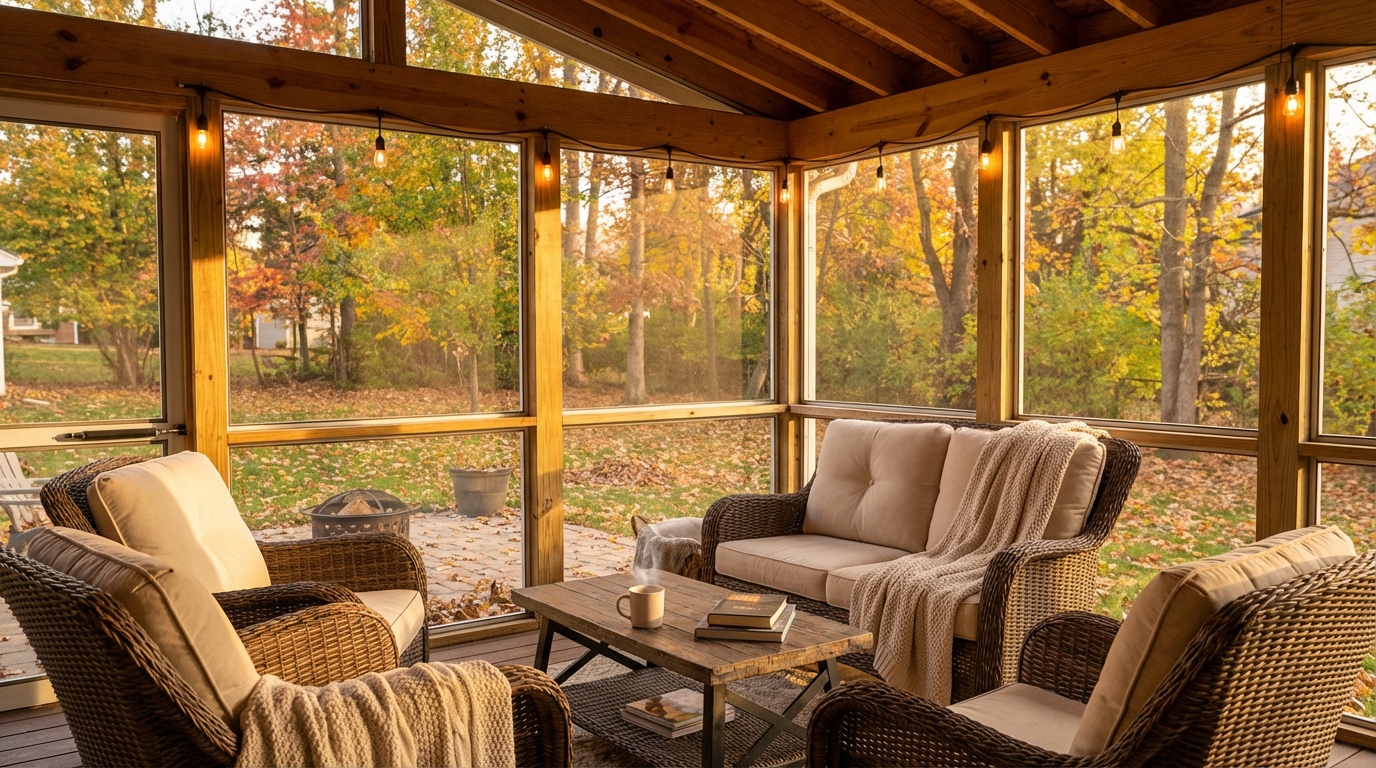
A three-season porch is an enclosed outdoor living space designed to be comfortable during spring, summer, and fall—but not winter. These spaces typically feature:
- Large screened or glassed windows (often single-pane or low-grade double-pane)
- No permanent heating or cooling systems
- Minimal insulation in walls and ceiling
- Lighter construction than a full room addition
- A floor that may be wood decking, concrete, or tile—not always insulated subflooring
The temperature inside a three-season porch tracks closely with outdoor temperatures. In most U.S. climate zones, this means it’s genuinely usable from roughly April through October—hence the name.
What Defines a Four-Season Porch?
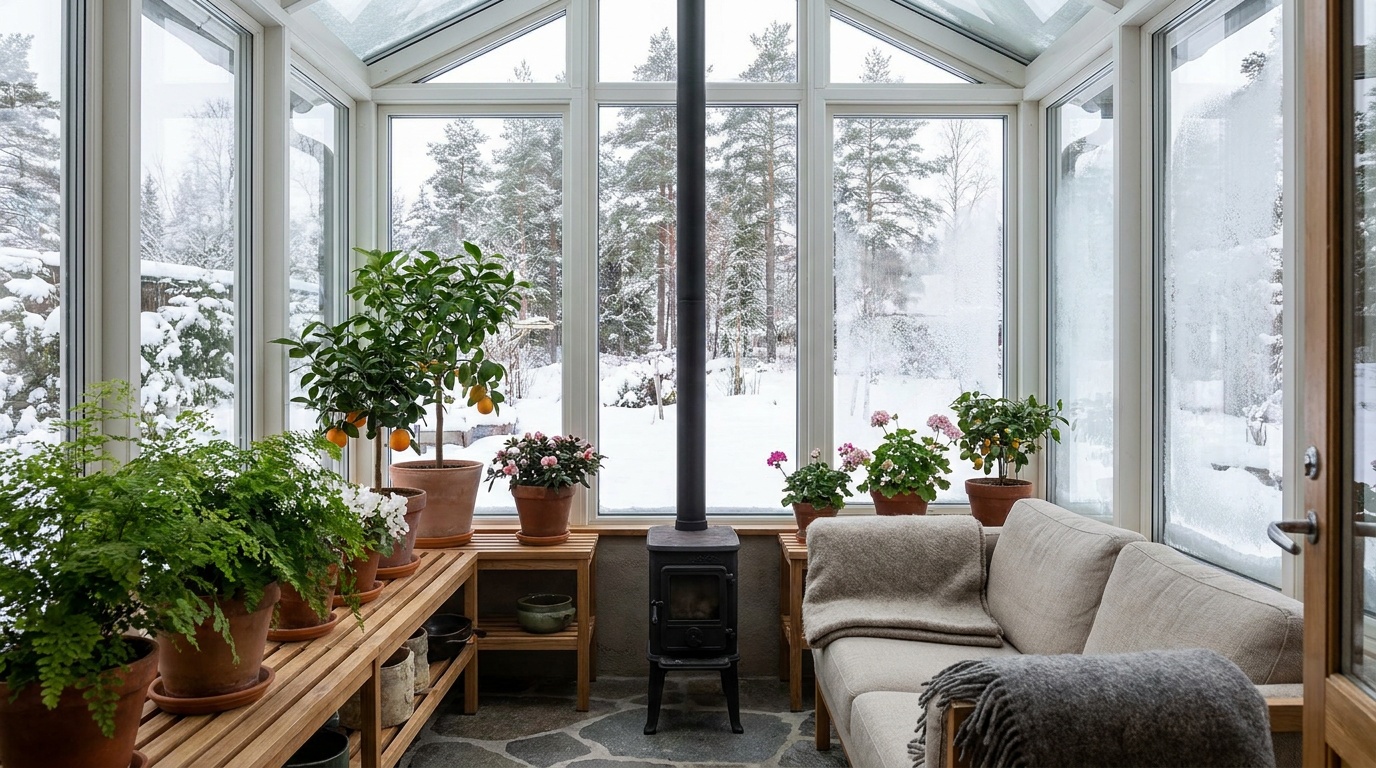
A four-season porch—sometimes called a sunroom addition or all-season room—is a fully conditioned, insulated living space that functions year-round. Key characteristics include:
- Insulated walls, ceiling, and flooring (meeting or exceeding local energy codes)
- Connection to the home’s HVAC system, or a dedicated mini-split system
- High-performance double- or triple-pane windows
- Proper vapor barriers and weatherproofing
- Electrical outlets, lighting, and sometimes plumbing
- A finished interior that matches the quality of the main living space
In practical terms, a four-season porch is more of a room addition with large windows than it is a traditional porch. It’s livable in January in Minneapolis just as comfortably as in July in Atlanta.
Three-Season Porches: A Deep Dive
Don’t let the “three-season” label make you think this option is somehow inferior. For millions of homeowners—particularly those in mild climates or with seasonal living preferences—a three-season porch is the smarter choice.
The Real Appeal of Going Three-Season
Think about your actual lifestyle for a moment. If you live in the Pacific Northwest, the Southeast, or coastal areas, your winters are mild enough that a well-placed propane heater or electric space heater extends usability well past October. You might find that a three-season porch covers 10 to 11 months of genuine comfort with far less investment.
Beyond climate, three-season porches offer real structural and financial flexibility:
- Faster permitting: In many jurisdictions, three-season porches don’t trigger the same level of building inspection as conditioned space additions. This can shave weeks off your project timeline.
- Lower construction complexity: No HVAC integration means your contractor roster is smaller and scheduling is simpler.
- Easier future conversion: A well-built three-season porch can be upgraded to four-season later—if your needs or budget change.
- Authentic outdoor connection: Many homeowners actually prefer the feel of a screened or lightly enclosed space that keeps them closer to nature while providing bug and weather protection.
Limitations You Should Honestly Evaluate
Balanced perspective matters here. Three-season porches have real limitations:
- They are not classified as conditioned square footage, which affects resale appraisals differently across markets.
- Furniture and décor must be chosen with temperature fluctuations in mind—materials that handle humidity and cold without warping or fading.
- In cold-climate states like Minnesota, Wisconsin, or Vermont, the usable season shrinks significantly without supplemental heat.
- Moisture management requires attention—screens and single-pane glass don’t prevent condensation or drafts the way a sealed, insulated system does.
Four-Season Porches: A Deep Dive
If the three-season porch is a comfortable bridge between indoors and outdoors, the four-season porch is a full commitment to expanding your livable square footage—one that comes with commensurate rewards and costs.
Why Four-Season Porches Are Gaining Popularity in 2026
According to the National Association of Home Builders (NAHB) 2025 annual report, sunroom and enclosed porch additions ranked among the top five most-requested home improvement projects for the third consecutive year. The shift toward work-from-home and hybrid work schedules—which have fundamentally reshaped how Americans use their homes since 2020—continues to drive demand for versatile, comfortable living spaces that don’t feel like ordinary rooms.
In 2026, the appeal of the four-season porch is amplified by several converging trends:
- Energy-efficient glass technology: Triple-pane windows with low-emissivity coatings and argon gas fills have dropped significantly in price over the past three years, making the thermal performance of a four-season porch far more achievable without breaking the budget.
- Mini-split HVAC systems: Ductless mini-split systems are now a standard, cost-effective option for conditioning sunrooms without requiring major modifications to the home’s existing HVAC infrastructure.
- Biophilic design demand: The growing focus on biophilic design—incorporating natural light, outdoor views, and plant-friendly spaces into home interiors—has made sunrooms and four-season porches a top priority for lifestyle-driven homeowners.
The Full-Year Utility Advantage
Here’s a scenario worth considering: you work remotely two days a week. Your four-season porch, bathed in natural light and insulated against winter cold, becomes your home office, your yoga studio, your reading nook, and your dinner party venue—all twelve months of the year. That’s not just comfort. That’s a functional addition that earns its cost through daily utility.
Homeowners who build four-season porches frequently report that the space becomes the most-used room in the house within the first year. The combination of natural light, panoramic views, and year-round accessibility creates a room that integrates into daily life in ways a spare bedroom or formal dining room rarely does.
The Challenges You Need to Plan For
A four-season porch is a significant construction project. Planning missteps are costly:
- Foundation requirements: Unlike a deck or screened porch, a four-season addition typically requires a full frost-depth foundation in cold climates—adding cost and complexity.
- Permitting and code compliance: This is treated as a full room addition in most jurisdictions, requiring architectural plans, energy code compliance, and multiple inspections.
- HVAC load calculations: Rooms with large glass areas are thermally demanding. Improperly sized HVAC systems lead to uncomfortable temperature swings and high energy bills.
- Thermal bridging: If construction details aren’t executed carefully, the large glass surfaces can create heat loss in winter and heat gain in summer that overwhelms your comfort systems.
Cost Comparison: What You’ll Actually Spend in 2026
Let’s talk real numbers. Material and labor costs have stabilized somewhat after the volatility of 2022–2024, but 2026 construction costs still reflect elevated baseline pricing compared to pre-pandemic norms. Here’s what homeowners are realistically spending:
| Factor | Three-Season Porch | Four-Season Porch |
|---|---|---|
| Average Cost (200 sq ft) | $18,000 – $35,000 | $45,000 – $90,000+ |
| Cost Per Square Foot | $90 – $175 | $225 – $450 |
| Permit Complexity | Low to Moderate | High |
| Construction Timeline | 3 – 8 weeks | 8 – 20 weeks |
| Average ROI at Resale | 50 – 65% | 65 – 80% |
Note: Costs reflect U.S. national averages for 2026. Regional variation is significant—Northeast and Pacific Coast markets typically run 25–40% above these figures; Southeast and Midwest markets may come in at or below these ranges.
Pro Tip: Get at least three contractor quotes and ask each one to specify material grades, foundation approach, and HVAC strategy. Scope variations between bids are often the source of confusion when homeowners try to compare apples-to-apples pricing.
ROI and Home Value: The Numbers That Matter
Let’s address the investment angle directly, because this shapes many homeowners’ decisions at least as much as personal preference does.
According to Remodeling Magazine’s 2025 Cost vs. Value Report—the most widely cited benchmark in the industry—sunroom additions (four-season) returned an average of 72.3% of project cost at resale in U.S. markets. Three-season porch additions, while not separately tracked in most national surveys, generally return 55–65% based on regional appraisal data compiled by the National Association of Realtors.
Here’s the nuance that matters: ROI varies dramatically by climate zone. In cold-climate states like Michigan, Illinois, or New York, a four-season porch commands a significantly higher premium because buyers can immediately envision year-round utility. In warm-climate states like Florida, Texas, or Arizona, a well-executed three-season screened porch may actually be preferred by buyers who value outdoor connectivity over full enclosure.
“In our market, a quality four-season sunroom addition is one of the fastest value-adds we see for mid-tier homes in the $350,000–$650,000 range. Buyers have mentally already allocated how they’d use the space before they’ve finished the walkthrough.” — Jennifer Calloway, Realtor and Certified Residential Specialist, Minneapolis, MN (2025)
One important caveat: over-improving for your neighborhood is a real risk. If your home is in a neighborhood where houses sell for $280,000–$320,000, spending $85,000 on a premium four-season porch is unlikely to return that investment at sale. Match the scope and quality of your addition to the realistic ceiling of your local market.
Real-World Scenarios: Two Homeowners, Two Choices
Scenario 1: The Ramirez Family in Nashville, Tennessee
Marcus and Elena Ramirez own a 1,850 sq ft craftsman bungalow in a Nashville suburb. They wanted to extend their outdoor entertaining space without adding another formal room to the house. Nashville’s climate averages 46°F in January and 89°F in July—warm enough that winters are mild but summers are genuinely hot and humid.
After consulting with two contractors and a local real estate agent, they chose a three-season screened porch with composite decking, a ceiling fan system, and a small outdoor kitchen rough-in. Total project cost: $27,500. Construction took six weeks.
Two years later, they use the porch from March through November without any supplemental heating. During summer, the ceiling fans and strategic screening make it surprisingly comfortable even in July heat. Their home appraised $18,000 higher after the addition—a return of approximately 65% of project cost. More importantly, Marcus reports the porch has become the family’s primary living space during warm months. “We barely use the formal living room anymore from April to October,” he says.
Scenario 2: The Thornton Family in Burlington, Vermont
David and Sarah Thornton have a 2,400 sq ft colonial in Vermont, where winters are serious—temperatures regularly drop below 10°F from December through February. They wanted a space that could serve as a home office and family gathering area year-round, with abundant natural light to offset Vermont’s notoriously gray winters.
They built a 240 sq ft four-season sunroom addition on the south-facing rear of their home, with triple-pane windows, radiant floor heating, and a dedicated mini-split unit for cooling in summer. Total project cost: $74,000. Construction took 14 weeks.
The result? David now works from the sunroom four days a week. The family uses it as a breakfast room and reading space year-round. Their home appraised $54,000 higher—a 73% return on project cost. Sarah notes: “During a Vermont February, having a room that feels like you’re sitting in a greenhouse is worth every penny. It genuinely changed how we feel about our house in winter.”
Key Decision Factors: What Should Guide Your Choice
Now that you have the full picture, let’s synthesize this into a practical decision framework. Five factors should anchor your choice:
1. Your Climate Zone
This is the single biggest determining variable. Use this simple heuristic: if your area experiences more than 60 days per year where the outdoor temperature is below 35°F, a three-season porch will have a meaningfully shorter usable season, making a four-season investment more justifiable.
2. Your Primary Use Case
Be honest about what you’ll actually do in the space. Casual weekend entertaining? A three-season porch is likely sufficient and delivers more authentic outdoor ambiance. Year-round home office? Guest overflow room? Daily family living space? Four-season wins decisively.
3. Your Budget and Timeline
Don’t stretch into a four-season project if doing so means compromising on construction quality to hit a budget. A well-built three-season porch outperforms a poorly constructed four-season sunroom in every dimension. Quality of execution matters more than category of project.
4. Your Resale Horizon
If you plan to sell within 3–5 years, ROI considerations should weigh heavily in your decision. If you’re staying for 10+ years, prioritize livability and personal utility over resale math.
5. Your Home’s Architecture and Orientation
A south-facing four-season sunroom with passive solar design can dramatically reduce winter heating costs. A north-facing addition of the same type may feel perpetually cold and dark. Similarly, a three-season porch that flows naturally from your kitchen or main living area integrates into daily life better than one that requires a detour through a utility room to access.
At-a-Glance: Overall Suitability Score by Use Case
The following chart compares suitability ratings (out of 100) for three-season versus four-season porches across five key use cases, based on homeowner satisfaction surveys compiled through 2025.
Warm-Climate Casual Entertaining
Year-Round Home Office
Cold-Climate Family Living Space
Budget-Conscious Value Addition
Resale Value in Cold Markets
Source: Homeowner satisfaction composite scores based on NAHB and NAR survey data, 2025.
Frequently Asked Questions
Can I convert a three-season porch to a four-season porch later?
Yes, but the conversion is rarely as simple or affordable as homeowners expect. The key constraints are foundation depth, wall framing insulation capacity, and HVAC integration. A three-season porch built on a shallow deck-style foundation may need significant structural work to support the thermal and load requirements of a conditioned space. If you think four-season is in your future, tell your contractor upfront—they can frame walls with deeper bays to accommodate insulation, rough in electrical for future HVAC, and specify a foundation that won’t need to be rebuilt. Planning for conversion from the start saves 30–50% compared to a complete retrofit later.
Will a four-season porch significantly increase my energy bills?
It depends entirely on how well it’s built and how you manage it. A poorly insulated sunroom with low-performance glass can add 15–25% to your heating and cooling costs. However, a properly designed four-season porch with triple-pane windows, quality insulation, and a correctly sized mini-split system typically adds only 8–12% to annual energy costs—and a south-facing design with passive solar principles can partially offset its own heating load in winter. Ask your contractor for an energy model estimate before finalizing the design. In 2026, energy modeling software is inexpensive and widely available—any quality contractor should be able to provide basic projections.
Do I need a permit for a three-season porch?
In almost all jurisdictions in the United States, yes—you will need at least a building permit, and in many cases a zoning review as well. The specific requirements vary significantly by municipality. A screened porch addition attached to your home’s structure will typically require a building permit covering structural elements, electrical work, and egress compliance. Some jurisdictions treat three-season porches more lightly than four-season additions (which are classified as conditioned square footage), but you should never assume a permit isn’t required. Unpermitted additions create serious complications at resale and can trigger costly remediation requirements. Always verify with your local building department before breaking ground.
Your Porch Decision Roadmap: Five Steps to Move Forward Confidently
You’ve absorbed a lot of information. Now let’s convert it into action. Here’s a clear, sequential roadmap to take you from “thinking about it” to “breaking ground” with confidence.
- Define your primary use case in writing. Not a vague sense of “I want outdoor space,” but a specific description: “I want a room where I can work from home three days a week, January through December, with natural light and a view of the backyard.” This single exercise will eliminate half your uncertainty immediately.
- Check your climate zone and local building codes. The U.S. Department of Energy’s climate zone map is free and takes five minutes to consult. Your local building department’s website will show permit requirements. Do this before talking to contractors—it makes you a far more informed buyer.
- Get three qualified contractor quotes with written scope documents. In 2026, the contractor market remains competitive. Insist on written scope that specifies foundation type, insulation R-values, window performance ratings (U-factor and SHGC), and HVAC approach. Comparing vague verbal quotes is how homeowners get burned.
- Consult a local real estate professional about market ceiling. A 15-minute conversation with an experienced local Realtor about comparable sales can save you from over-improving for your neighborhood—or from under-investing when the market would reward a premium addition.
- Align your timeline with the construction season. In most U.S. markets, starting a porch project in late winter or early spring (February–April) gives you the best contractor availability and positions you for completion before peak-use season. Waiting until summer often pushes completion into fall.
As hybrid work models continue to reshape how Americans use their homes in 2026 and beyond, the demand for versatile, comfortable living spaces that blur the boundary between indoors and outdoors will only accelerate. Your porch—whether three-season or four-season—isn’t just a construction project. It’s an investment in the quality of your daily life, the personality of your home, and your connection to the outdoor world on your own terms.
So here’s the question worth sitting with: When you picture yourself in this new space five years from now—what month is it, what’s the temperature outside, and what are you doing? That vision, more than any spreadsheet or ROI calculation, will point you toward the right choice.
Article reviewed by Gary Kowalski, Structural Demolition & Load-Bearing Analysis Expert, on May 4, 2026